cloud
How to Self Publish a Book From Start to Finish

How to Self Publish a Book From Start to Finish

A Comprehensive Guide for Authors

Learning how to self publish a book involves far more than simply uploading a manuscript to Amazon. While platforms like Kindle Direct Publishing have made publishing more accessible, creating a professional-quality book still requires careful planning, strong editing, proper formatting, high-quality cover design, and a clear publishing strategy.

Many first-time authors assume self publishing is a quick process because Amazon allows free uploads. In reality, professionally published books usually go through multiple production stages before they are ready for readers. These stages often include manuscript development, editing, illustration planning, interior formatting, print preparation, metadata optimization, pricing strategy, and post-launch marketing.

Whether you are publishing a children’s picture book, illustrated story book, novel, educational title, or Kindle ebook, each publishing decision directly affects the final quality of the book. Weak editing, poor formatting, low-resolution illustrations, or incorrect print setup can make even a strong story appear unprofessional in the marketplace.

Modern self publishing also gives authors much greater creative and financial control compared to traditional publishing. Authors can retain ownership rights, choose their own illustrator company or book publishing service, control pricing, publish globally through Amazon publishing platforms, and update their books whenever needed.

However, this freedom also means authors become responsible for decisions that traditional publishers normally handle internally. Understanding the complete publishing workflow before production begins can help authors avoid expensive revisions, production delays, and common self publishing mistakes.

This guide explains how to self publish a book from start to finish, covering every major stage of the process including writing, editing, book illustrations, formatting, Amazon KDP publishing, paperback and hardcover setup, Kindle conversion, pricing, and long-term book marketing.

What Does It Mean to Self Publish a Book?

How to Self Publish a Book From Start to Finish Guide for First Time Authors

Self publishing means producing and distributing a book independently without signing with a traditional publishing house. Instead of submitting manuscripts to literary agents or waiting for publisher approval, authors directly control the entire publishing process themselves.

In traditional publishing, the publisher usually manages editing, cover design, printing, distribution, and marketing decisions. In self publishing, those responsibilities shift to the author. This means the author either learns the production process personally or works with professional book publishing services, editors, formatters, cover designers, and Children’s Book Illustration Services to prepare the book professionally.

Over the last decade, Amazon self publishing has significantly changed the publishing industry. Platforms such as Kindle Direct Publishing now allow authors to publish paperback, hardcover, and ebook editions globally without large upfront printing investments. Print-on-demand technology also allows books to be printed only when customers place orders, reducing inventory costs for independent authors.

However, accessibility should not be confused with simplicity. While almost anyone can technically upload a file to Amazon, professionally self published books usually require careful production standards similar to those used by traditional publishing companies.

For example, a professionally self published children’s book may involve:

This is why many experienced authors approach self publishing not simply as “uploading a book,” but as building a complete publishing product that can compete professionally in the marketplace.

Why More Authors Are Learning How to Self Publish a Book

More writers are learning how to self publish a book because self publishing offers greater creative control, faster production timelines, and higher ownership compared to traditional publishing. Modern Amazon self publishing platforms now allow independent authors to publish paperback, hardcover, and ebook editions globally while maintaining full control over editing, illustrations, formatting, pricing, and marketing decisions.

Authors can independently choose their preferred illustrator company, book editing services, cover designer, formatting specialist, and book publishing service provider based on the needs of their project. This flexibility has made self publishing companies Amazon authors use increasingly popular among first time and experienced writers alike.

For children’s book authors, self publishing is especially valuable because it provides complete control over visual storytelling, character design, page layout, illustration style, and overall book presentation. Many authors working on picture books therefore combine professional Children’s Book Illustration Services with experienced book publishing services to create high quality books suitable for Amazon Kindle Direct Publishing and print distribution platforms.

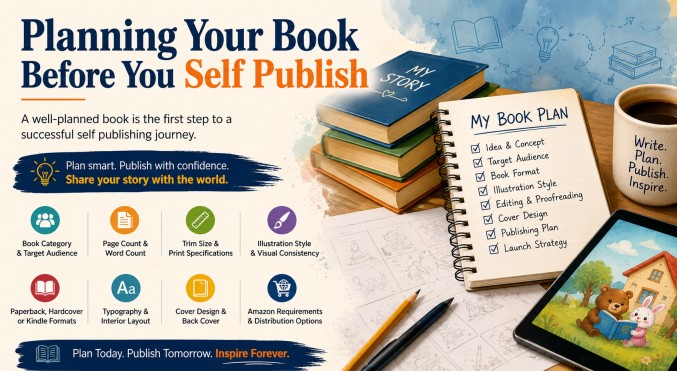
Planning Your Book Before You Self Publish

Planning your book before self publishing including formatting, illustration, and publishing preparation

Before beginning the self publishing process, authors should carefully plan the type of book they want to create. Different categories such as novels, picture books, children’s story books, activity books, educational books, and illustrated books often require different production methods, formatting standards, illustration styles, and publishing strategies.

Proper planning is an important step for authors learning how to self publish a book because early publishing decisions can affect printing costs, reader experience, Amazon visibility, and overall book quality.

Important publishing decisions usually include:

Many authors also work with professional book editing services, Children’s Book Illustration Services, formatting specialists, and experienced book publishing services during the planning stage to ensure the book is professionally prepared for Amazon Kindle Direct Publishing and print-on-demand distribution platforms.

How to Write a Book Before Self Publishing

The manuscript is the foundation of every successful book. Before investing in illustrations, formatting, cover design, or book publishing services, authors should first focus on creating a well structured and professionally written manuscript. A strong story not only improves reader experience, but also increases the long term success of the book on Amazon self publishing platforms and other publishing marketplaces.

Authors learning how to self publish a book should understand that writing and publishing are separate stages of the process. Even the best illustrations or marketing strategies cannot fully compensate for weak storytelling, inconsistent pacing, or unclear writing. Careful manuscript development is therefore one of the most important steps in professional self publishing.

For authors researching how to publish children’s story books, the writing should be clear, age appropriate, engaging, and easy to follow. Children’s books often require shorter sentences, stronger emotional moments, and visual storytelling opportunities that allow illustrations and text to work together naturally.

Picture books especially rely heavily on page pacing because every page turn helps build curiosity, emotion, humor, or suspense. The manuscript should therefore be written with illustration placement, scene transitions, and visual flow in mind from the beginning.

Important writing considerations before self publishing include:

Many independent authors also work with professional book editing services before moving into illustration or formatting. Editing can help improve story structure, sentence flow, readability, pacing, and overall publishing quality before the manuscript enters production.

Can You Use AI to Write a Book?

AI writing tools have become increasingly common in modern self publishing, and many authors now use AI during brainstorming, outlining, idea generation, title research, or early draft preparation. However, most successful self published books still require strong human editing, creativity, emotional storytelling, and professional revision.

For children’s books especially, relying entirely on AI generated writing can sometimes create problems such as repetitive wording, weak emotional depth, inconsistent character voices, inaccurate age targeting, or unnatural dialogue. Readers often connect more strongly with stories that include authentic human experiences and carefully developed storytelling.

AI can still be helpful when used responsibly during the writing process. Many authors use AI tools for:

Authors planning to publish professionally on Amazon Kindle Direct Publishing should still review, rewrite, edit, and personalize AI assisted content carefully before publication. Combining human creativity with professional editing and publishing experience generally produces stronger long term publishing results than relying entirely on automated writing tools alone.

Why Editing Is Important When You Self Publish a Book

Professional book editing services play an important role in the self publishing process because they help improve grammar, sentence flow, story structure, readability, pacing, and overall manuscript quality. Even well written manuscripts often benefit from professional editing before moving into illustration, formatting, or Amazon self publishing production stages.

Authors learning how to self publish a book should understand that editing involves much more than correcting spelling mistakes. Professional editors often review the manuscript for consistency, dialogue clarity, emotional flow, scene transitions, repetitive wording, and overall reader engagement. Strong editing can significantly improve both the reading experience and the long term success of the book.

Editing is especially important for first time authors because publishing errors can become more expensive and time consuming to correct later after page layout, illustrations, formatting, or cover design have already started. Revising text after the illustration process may also require page redesigns, typography adjustments, and illustration repositioning.

Common areas professional book editing services usually improve include:

For authors researching how to publish children’s story books, editing is particularly important because children’s literature often requires concise storytelling, simple sentence structure, age appropriate vocabulary, and smooth page pacing. Picture books especially rely on carefully balanced text that works naturally alongside illustrations.

Many experienced self publishing authors therefore complete editing before hiring Children’s Book Illustration Services, formatting specialists, or book publishing services. A professionally edited manuscript usually creates a smoother publishing workflow and reduces production revisions later during the publishing process.

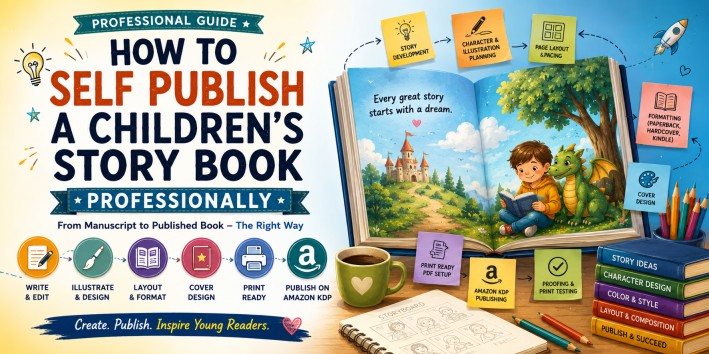
How to Self Publish a Children’s Story Book Professionally

Professional children's story book self publishing process including illustration, formatting, and Amazon KDP publishing

Learning how to publish children’s story books involves much more than simply uploading a manuscript online. High quality children’s book publishing combines storytelling, editing, illustration planning, typography, formatting, cover design, and print production into one complete publishing process.

Unlike standard novels, children’s books rely heavily on visual storytelling. The illustrations, page layout, typography, colors, and pacing all work together to shape the reading experience. Because of this, production quality becomes especially important when self publishing children’s books through Amazon self publishing platforms.

Children’s books also require much more visual and structural planning than most standard books. Authors often need to consider illustration placement, page turns, text balance, reading flow, character consistency, and age appropriate visual storytelling long before the final artwork or formatting stage begins.

One of the most important parts of publishing a children’s book is planning how the illustrations will support the story. Some books require full page illustrations on every spread, while others use spot illustrations, decorative elements, or double page illustration spreads. The illustration style should also match the target age group because books for toddlers, early readers, and middle grade audiences often use very different visual approaches.

Authors should also decide early whether the project will be published as paperback, hardcover, Kindle ebook, or all three formats. These decisions influence trim size, page count, printing costs, layout structure, and formatting requirements throughout the entire production process.

Picture books especially depend on strong page pacing because every page turn helps build emotion, curiosity, humor, suspense, or movement in the story. Professional Children’s Book Illustration Services often create detailed page planning and storyboards before final illustrations begin so the visual flow of the book remains consistent from beginning to end.

Technical production quality is equally important when self publishing children’s books. Problems such as low resolution illustrations, incorrect bleed setup, poor typography, formatting errors, or improperly prepared print files can negatively affect the final print quality and reader experience.

Proper print production usually includes:

Because children’s book publishing involves both creative and technical production stages, many independent authors work with experienced book publishing services, editors, formatters, cover designers, and Children’s Book Illustration Services instead of attempting every stage alone.

Hiring experienced publishing experts can help authors improve story structure, illustration consistency, formatting accuracy, print quality, and overall publishing presentation. Expert publishing guidance can also help reduce costly revisions during production while ensuring the final book meets Amazon self publishing quality standards.

Creating a Picture Book Before Publishing on Amazon

Creating a picture book for Amazon self publishing requires both creative storytelling and professional production planning. Unlike standard novels, picture books depend heavily on visual storytelling, page pacing, illustration flow, typography, and layout structure to create a complete reading experience for children.

In children’s publishing, illustrations often carry a significant portion of the narrative. Character expressions, scene composition, colors, movement, and page transitions all help communicate emotion, humor, curiosity, and story progression. Because of this, successful picture books require careful coordination between manuscript development and illustration planning.

Professional picture book production usually begins with storyboard development and page mapping. This stage helps determine illustration placement, text balance, page turns, scene pacing, and overall visual consistency throughout the book. Proper page planning is especially important because overcrowded layouts, poor text placement, or inconsistent illustrations can negatively affect readability and reader engagement.

Authors should also decide early whether the book will use full page illustrations, spot illustrations, decorative elements, or cinematic double page spreads. The illustration style should match both the manuscript tone and the intended age group, since books for toddlers, early readers, and middle grade audiences often require different visual approaches.

Technical print preparation is equally important when creating a picture book for Amazon Kindle Direct Publishing platforms. High quality children’s books usually require 300 DPI illustrations, proper bleed setup, safe text margins, CMYK color preparation, accurate trim sizing, and professionally formatted print ready PDF files.

Many independent authors therefore work with experienced story book illustrators, illustration firms, and Children’s Book Illustration Services that understand both visual storytelling and Amazon publishing requirements. Professional publishing support can help improve illustration consistency, formatting quality, print accuracy, and the overall presentation of the final book.

How to Find the Right Author Illustrators and Story Book Illustrators

How to hire a professional book illustrator for children's books and self publishing projects

Choosing the right illustrator is one of the most important decisions in children’s book publishing because the artwork strongly influences the visual identity and emotional impact of the story. Professional author illustrators should be able to create expressive characters, visually engaging scenes, and consistent artwork that supports the manuscript from beginning to end.

When evaluating story book illustrators, authors should review the illustrator’s portfolio carefully to examine character consistency, scene composition, background detail, color balance, emotional expression, and storytelling ability. Strong children’s book illustrations should maintain a consistent visual style across every page while supporting the pacing and tone of the story.

It is also important to choose artists who understand children’s publishing production standards rather than only general digital illustration. Experienced Children’s Book Illustration Services often provide knowledge of typography spacing, bleed setup, print resolution requirements, cover preparation, page layout planning, and Amazon Kindle Direct Publishing specifications.

A professional illustrators website should clearly display published book samples, illustration styles, project examples, service details, revision policies, and publishing experience. Reviewing complete book projects instead of only standalone artwork can help authors better evaluate how the illustrator handles storytelling across an entire children’s book.

Authors should additionally discuss communication workflow, illustration timelines, ownership terms, revision stages, and publishing goals before beginning production. Clear project planning can help reduce delays, avoid inconsistent artwork, and improve the overall efficiency of the publishing process.

Many independent authors choose professional illustration studios or illustration agencies because they often provide structured publishing workflows that combine illustration, formatting, cover design, and print preparation into one coordinated production process.

For a detailed article on choosing the right illustrator for your children’s book, read: How to Choose the Right Book Illustrator for Your Children’s Book.

Designing a Professional Book Cover for Self Publishing

A professionally designed book cover plays a major role in the success of any self published book because it creates the first impression readers see while browsing Amazon, Kindle, Barnes & Noble, or other online bookstores. In many cases, the cover design directly influences whether a potential reader clicks on the book listing or continues scrolling past it.

Strong book covers combine effective typography, professional illustration or imagery, balanced composition, and genre-appropriate visual styling to attract the correct target audience.

Professional children’s book cover design by Blueberry Illustrations

A well-designed cover should communicate the tone, subject matter, and reading experience of the book within seconds while remaining visually clear at both full size and small Amazon thumbnail size.

Professional self publishing cover design also involves important technical production requirements including accurate trim dimensions, spine calculations, bleed setup, barcode placement, print-safe margins, and high-resolution export settings for both paperback and hardcover publishing. Authors should also ensure the back cover includes properly formatted descriptive text, author information, ISBN barcode space, and visually consistent branding across the entire wraparound design.

For children’s books, illustrated novels, and picture books, cover artwork becomes even more important because visual storytelling strongly influences reader engagement. Since book cover design combines both creative storytelling and technical publishing preparation, many authors choose to work with experienced Children’s Book Illustration Services and professional self publishing design teams to ensure the final cover looks polished, marketable, and fully print ready for Amazon publishing platforms.

How to Format Your Book for Print and Kindle Publishing

Book formatting is the process of preparing a manuscript and its visual elements for professional print production and digital distribution. Proper formatting ensures that the book displays correctly across paperback, hardcover, and Kindle publishing platforms while maintaining readability, visual consistency, and technical publishing standards.

Print book formatting typically involves adjusting the interior layout according to the selected trim size and printing specifications. This includes configuring page margins, gutter spacing, bleed areas, image resolution, typography styling, page numbering, and chapter placement. Incorrect formatting may result in printing defects, misaligned content, low-quality image reproduction, or rejected files during the publishing review process.

Kindle book formatting requires separate optimization because digital books must adapt to different screen sizes and reading devices. Ebook formatting generally includes reflowable text conversion, clickable table of contents creation, image optimization, metadata preparation, and compatibility testing across Kindle readers, tablets, and mobile applications.

Authors planning to publish book Kindle editions should ensure the ebook version is professionally converted and tested before upload to avoid formatting inconsistencies, missing elements, navigation errors, or display problems on Amazon Kindle devices.

How to Publish a Book on Amazon Step by Step

Amazon Kindle Direct Publishing (KDP) is one of the largest self publishing platforms used for distributing paperback, hardcover, and Kindle ebook editions globally. The platform allows independent authors to publish books without working through a traditional publishing house while maintaining control over pricing, royalties, distribution, and publishing rights.

The Amazon publishing process generally begins with creating a KDP account and preparing all production files according to Amazon’s technical specifications. Authors are required to enter detailed metadata including the book title, subtitle, series information, author name, description, keywords, age ranges, categories, and publishing territories. After the metadata setup is complete, the interior manuscript files and full cover files are uploaded separately for paperback, hardcover, and Kindle editions.

For print publishing, Amazon KDP requires properly formatted PDF interior files with accurate trim size configuration, bleed settings, embedded fonts, image resolution, safe margin spacing, and correct page sequencing. Cover files must match Amazon’s calculated spine width and include correct front cover, spine, and back cover dimensions. Even small formatting inconsistencies may cause text shifting, image cropping, printing defects, or file rejection during the review process.

Kindle publishing requires additional digital optimization because ebook files behave differently from printed pages. Kindle formatting often involves reflowable text conversion, clickable navigation setup, image optimization, hyperlink testing, device compatibility adjustments, and validation for multiple screen sizes. Books that appear visually correct in print format may still display incorrectly on Kindle devices if the ebook conversion is not handled properly.

Once all files are uploaded, Amazon KDP generates a digital preview that allows authors to inspect the layout, margins, image placement, spine alignment, and ebook functionality before submission. Authors must then finalize pricing, royalty options, print territories, and distribution settings before sending the book for Amazon review and approval.

Although Amazon self publishing appears straightforward at the surface level, the actual publishing workflow combines technical production knowledge, publishing standards, typography preparation, digital formatting, print engineering, metadata optimization, and marketplace positioning. For this reason, many authors work with experienced book publishing services, Children’s Book Illustration Services, and professional formatting specialists to reduce production errors and improve the overall quality of the final publication.

Setting Up Paperback, Hardcover, and Ebook Versions

Professional self publishing often involves preparing multiple editions of the same title for different reading preferences and sales channels. Paperback editions are generally used for standard retail distribution because they are cost effective, lightweight, and widely accepted across Amazon marketplaces. Hardcover editions are commonly used for premium releases, collector editions, libraries, educational markets, and gift-oriented publishing because they provide greater durability and higher perceived value.

Kindle ebook editions serve a separate digital audience and require independent formatting preparation. Unlike print books, Kindle books must adapt dynamically to different screen dimensions, font resizing, reading orientations, and device settings. As a result, ebook formatting usually follows a separate production workflow from paperback and hardcover layout design.

Each publishing format requires its own technical setup, including:

Managing multiple publishing formats also requires visual consistency across all editions so that typography, branding, illustration style, metadata, and interior presentation remain professionally aligned. Inconsistent formatting or poorly prepared files can reduce reader confidence, create production delays, or negatively affect customer reviews after publication.

Because of these technical and production requirements, many authors choose to work with experienced self publishing professionals instead of relying entirely on automated upload systems. Professional publishing teams can assist with print preparation, cover engineering, Kindle conversion, typography setup, metadata optimization, and final production review to ensure the completed book meets commercial publishing standards across all formats.

How Much Does It Cost to Self Publish a Book?

One of the most common questions asked by independent authors is how much does it cost to publish a book professionally. The total cost of self publishing depends on the type of book being produced, the level of editorial support required, the amount of artwork involved, the number of formats being published, and the marketing support needed after release.

Amazon Kindle Direct Publishing allows authors to upload paperback, hardcover, and Kindle ebook editions without charging an upfront upload fee. However, this does not mean that producing a professional book is completely free. A high-quality self published book usually requires investment in manuscript editing, cover design, book illustrations, interior formatting, Kindle conversion, publishing setup, and promotional preparation.

For text-based books, the main costs usually come from editing, proofreading, cover design, formatting, and marketing. For illustrated books, picture books, children’s books, workbooks, and graphic storytelling projects, the production cost is usually higher because these books require custom artwork, page-by-page layout planning, typography placement, print-ready image preparation, and separate file setup for paperback, hardcover, and ebook versions.

The final budget also depends on the author’s publishing goal. Some authors only want a simple personal book or family project, while others want a professionally produced title that can compete in the Amazon marketplace. Books intended for commercial sale usually need stronger editing, better cover design, consistent interior layout, professional illustrations, optimized metadata, and marketing assets.

Common self publishing expenses may include:

Authors should also consider indirect costs that are often overlooked during the planning stage. These may include revision charges, file correction fees, reformatting costs, replacement artwork, additional proof copies, advertising tests, website hosting, domain renewal, and future updates to the book after publication. A low initial quote may become more expensive if important services are excluded from the original package.

For this reason, self publishing should be viewed as a production process rather than only an upload process. The real cost is not limited to placing a book on Amazon; it includes preparing the manuscript, artwork, cover, layout, and marketing materials so that the final publication appears professional to readers.

Click here to read the detailed article

Choosing Affordable Book Publishers Without Sacrificing Quality

Choosing Affordable Book Publishers Without Sacrificing Quality

Affordable book publishers and self publishing service providers can be useful for authors who want professional support within a planned budget. However, the cheapest publishing option is not always the most cost-effective option. Poor editing, weak cover design, inconsistent illustrations, low-resolution artwork, or incorrect formatting can create technical problems and additional expenses later.

A professional publishing service should clearly explain what is included in the package and what may cost extra. Authors should check whether the service includes editing, illustration, cover design, interior formatting, Kindle conversion, paperback setup, hardcover setup, ISBN guidance, revision support, and final print-ready file delivery.

Before choosing a book publishing service, authors should compare:

Low-cost publishing services may appear attractive at the beginning, but incomplete production can affect the final quality of the book. Common problems include incorrect bleed, poor spine alignment, unreadable typography, weak image resolution, inconsistent character artwork, missing Kindle navigation, or files that do not meet Amazon publishing standards. Correcting these problems after layout or upload can be more expensive than preparing the book properly from the start.

Experienced book publishing professionals can help authors make better production decisions by planning the book correctly before work begins. This includes selecting the right trim size, estimating illustration needs, preparing the manuscript for layout, designing a marketable cover, formatting files according to Amazon requirements, and ensuring that all editions remain visually consistent.

For children’s books and illustrated books, working with professional Children’s Book Illustration Services is especially important because the artwork, page layout, cover design, and typography must work together as one complete reading experience. A well-planned illustrated book should not only look attractive but also support the pacing, emotion, and storytelling of the manuscript.

The best affordable publishing option is therefore not necessarily the lowest-priced provider, but the service that offers the strongest balance of quality, transparency, technical knowledge, and long-term publishing support. Choosing experienced professionals can reduce production errors, improve reader confidence, and help the final book appear more polished across Amazon paperback, hardcover, and Kindle platforms.

How to Market and Promote Your Self Published Book

Publishing a book is only one stage of the self publishing process. After the book becomes available on Amazon or other publishing platforms, authors must actively promote the title so that readers can discover it within a highly competitive marketplace. Even professionally written and well-designed books may struggle to gain visibility without consistent marketing and audience engagement.

Book marketing involves a combination of discoverability strategies, branding preparation, reader outreach, and long-term promotional planning. Successful self publishing authors often focus on improving Amazon search visibility, building an author platform, encouraging reader reviews, and creating promotional content that increases awareness of the book across multiple channels.

Common self publishing marketing strategies may include:

For children’s books and illustrated books, visual marketing materials can play an especially important role because readers and parents often respond strongly to artwork quality, character presentation, and overall visual branding. Professional promotional assets such as animated trailers, social media graphics, author websites, and optimized Amazon listings can help improve reader confidence and marketplace presentation.

Many authors therefore choose to work with experienced self publishing professionals, marketing specialists, and Children’s Book Illustration Services that understand both book production and post-publication promotion. A professionally planned marketing strategy can help increase visibility, strengthen branding, and improve the long-term commercial potential of a self published book.

For detailed information about marketing strategies and promotional ideas for independent authors, read this detailed article:

Self Publishing Ideas for Children’s Authors

Building Your Author Brand After You Self Publish a Book

Choosing Affordable Book Publishers Without Sacrificing Quality

Building an author brand is an important part of long-term self publishing success because it helps readers recognize, remember, and trust an author’s work across multiple books and publishing platforms. An effective author brand creates consistency between the author’s books, website, visual presentation, communication style, and overall reader experience.

Professional author branding often includes a dedicated author website, consistent cover design style, clear author biographies, optimized book descriptions, social media presence, and recognizable visual identity across Amazon listings and promotional materials. These elements help establish credibility while improving discoverability within competitive online marketplaces.

A strong author brand may also support long-term marketing and audience growth by helping readers identify future releases more easily. Authors who maintain consistent branding across multiple books often develop stronger reader recognition and improved engagement over time.

Common author branding elements may include:

For authors planning multiple books, series branding becomes especially important. Consistent character design, typography, cover layout, illustration style, and title structure can help readers immediately recognize connected books within the same series. Many successful children’s book authors use recurring characters, visual themes, and branded series pages to strengthen reader familiarity and encourage repeat purchases across future releases.

For children’s book authors and illustrated book creators, branding may extend beyond the book itself and include educational activities, printable worksheets, school visits, classroom presentations, reading sessions, themed social media content, and character-based promotional materials. Consistent visual branding can help strengthen reader familiarity with recurring characters, illustration styles, and storytelling themes.

Many independent authors therefore work with professional self publishing teams, designers, and Children’s Book Illustration Services to create a unified brand identity that supports both the current book and future publishing projects. A professionally developed author brand can improve reader trust, strengthen marketplace presentation, and contribute to long-term visibility across paperback, hardcover, and Kindle publishing platforms.


RECENTLY PUBLISHED BOOKS AND HAPPY AUTHORS

Common Mistakes Authors Make When They Self Publish a Book

Self publishing gives authors greater creative control and publishing independence, but it also requires careful planning across writing, editing, design, formatting, production, and marketing. Many first-time authors underestimate the technical and creative requirements involved in preparing a professional-quality book for Amazon paperback, hardcover, and Kindle publishing platforms.

One of the most common self publishing mistakes is skipping professional editing or relying only on automated grammar tools. Even strong manuscripts may contain structural inconsistencies, pacing issues, formatting problems, grammatical errors, or readability concerns that reduce the overall quality of the final publication. Professional editing helps improve clarity, consistency, and reader experience before the book enters production.

Authors also frequently encounter production problems caused by incorrect trim sizes, missing bleed setup, poor typography choices, low-resolution images, improperly formatted Kindle files, or cover designs that do not meet Amazon KDP specifications. Technical errors during formatting and file preparation may result in printing defects, upload warnings, rejected files, or reduced visual quality after publication.

Another common mistake is beginning illustration work before the manuscript has been finalized. Changes to the manuscript after sketches, page layouts, or final illustrations have already been created can increase production costs, delay project timelines, and require significant redesign work. This is especially important for children’s books, picture books, and heavily illustrated projects where artwork and text placement must remain carefully coordinated throughout the layout process.

Many authors also underestimate the importance of marketing and long-term branding. Publishing a book on Amazon does not automatically guarantee visibility or sales. Without keyword optimization, category planning, promotional preparation, reader outreach, and consistent branding, even professionally produced books may struggle to reach their intended audience.

Common self publishing mistakes may include:

Working with experienced publishing professionals, formatting specialists, cover designers, editors, and Children’s Book Illustration Services can help authors reduce these common production errors while improving the overall quality, presentation, and commercial readiness of the final book.

Final Thoughts on How to Self Publish a Book From Start to Finish

Learning how to self publish a book from start to finish allows authors to better understand the complete publishing workflow, including manuscript preparation, editing, illustration planning, formatting, cover design, Amazon setup, and post-publication marketing. Successful self publishing requires more than uploading a manuscript online; it involves combining creative storytelling with professional production standards and long-term publishing strategy.

A professionally produced self published book typically requires strong writing, careful editing, market-appropriate cover design, technically correct formatting, optimized metadata, and consistent branding across paperback, hardcover, and Kindle editions. Each stage of the publishing process contributes to the overall reader experience and influences how the book is perceived within competitive online marketplaces.

For children’s books, illustrated books, educational books, and visual storytelling projects, professional planning becomes even more important because illustration quality, typography placement, page composition, and print preparation all work together as part of the reading experience. Careful coordination between manuscript development, illustration, layout, and publishing setup can significantly improve the quality and consistency of the final publication.

Independent authors today have access to global publishing platforms, print-on-demand distribution, ebook publishing systems, and online marketing opportunities that were previously available only through traditional publishing companies. However, professional publishing standards still remain important for authors who want their books to appear polished, competitive, and commercially credible.

Whether an author is publishing a children’s story book, picture book, novel, workbook, educational title, or illustrated project, thoughtful planning and experienced publishing support can help transform a manuscript into a professionally prepared book that is visually polished, technically accurate, reader-friendly, and ready for long-term distribution across Amazon publishing platforms.

To explore more self publishing tips and resources that can guide you in writing, designing, and publishing your book, click on this link.

Click here to visit our Home Page.

Click here to view the portfolio of children’s book illustrations by Blueberry Illustrations: https://blueberryillustrations.com/childrens-book-illustrationsClick here to explore affordable publishing packages offered by Blueberry Illustrations: https://blueberryillustrations.com/affordable-publishing-packagesClick here to read author testimonials and reviews of Blueberry Illustrations: https://blueberryillustrations.com/book-reviewClick here to view the Amazon book store featuring books published by Blueberry Illustrations: https://blueberryillustrations.com/book-storeClick here to watch videos showcasing Blueberry Illustrations’ publishing and illustration work: https://blueberryillustrations.com/videos