Our Happy
Authors


A Comprehensive Guide for Authors: Compare Printing Costs, Pricing, Durability, and the Best Format for Your Book
If you're planning to self-publish a book, one of the first format decisions is whether to publish in hardcover or paperback. The choice affects printing cost, retail price, royalties, durability, and how readers perceive the finished book. It can also influence which format makes the most sense to publish first.
For many self-published authors, paperback offers a lower-cost and more affordable option for readers, while hardcover provides greater durability and a more premium presentation. However, the better choice depends on the type of book you are publishing. Children's picture books, illustrated books, gift books, and art books may benefit more from hardcover, while novels, memoirs, and many nonfiction titles are often well suited to paperback.
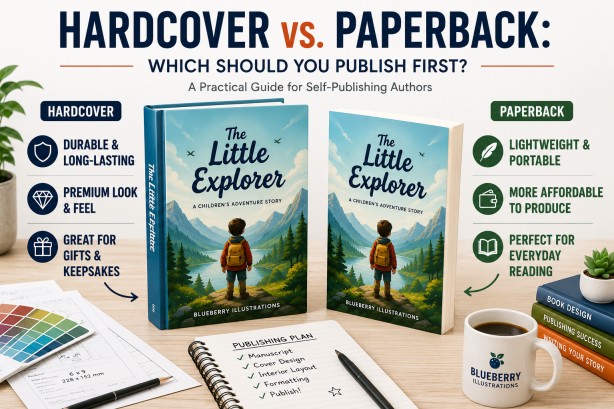
For most first-time authors publishing a novel, memoir, or text-driven nonfiction book, paperback is usually the more practical format to publish first. It has a lower printing cost, allows for a more accessible retail price, and gives authors an opportunity to gauge reader demand before adding a hardcover edition.
For children's picture books, illustrated books, art books, photography books, gift books, and other titles where presentation and durability are important, hardcover may be worth publishing first or alongside paperback. In these cases, the physical quality of the book is an important part of the reader's experience.
The right choice therefore depends on your book type, printing cost, target retail price, audience, and how important durability and premium presentation are to the finished book. The comparisons below explain where hardcover and paperback differ and when each format makes the most sense.
The main differences between hardcover and paperback self-publishing come down to printing cost, retail price, durability, presentation, and the type of book being published. Here is a quick comparison:
| Factor | Paperback | Hardcover |
|---|---|---|
| Printing Cost | Lower | Higher |
| Typical Retail Price | Lower and more affordable | Higher due to increased production cost and premium format |
| Durability | Less durable with a flexible cover | More durable with a rigid cover |
| Presentation | Practical and lightweight | More premium and substantial |
| Best Suited For | Novels, memoirs, general nonfiction, workbooks, and lower-priced editions | Children's picture books, illustrated books, gift books, art books, photography books, and premium editions |
| Best Choice When | Affordability and lower printing costs are priorities | Durability and premium presentation are priorities |
Hardcover and paperback are not simply two versions of the same book with different covers. The format you choose affects production cost, retail pricing, durability, presentation, and how practical the finished book is for its intended readers.
These differences matter differently depending on the book. A novel may benefit most from the affordability and portability of paperback, while durability and presentation may be more important for a children's picture book or gift title. The sections below compare these factors in more detail.
One of the biggest differences between hardcover and paperback self-publishing is the cost of producing each copy. With print-on-demand services such as Amazon KDP and IngramSpark, authors generally do not need to order a large quantity of books in advance. However, hardcover books normally cost more to manufacture than comparable paperback editions.
The actual printing cost depends on several factors, including:
| Cost Factor | Paperback | Hardcover |
|---|---|---|
| Printing Cost Per Copy | Generally lower | Generally higher |
| Typical Retail Price | Usually lower | Usually higher |
| Pricing Flexibility | More room to offer an affordable retail price | Higher production cost may require a higher retail price |
| Profit Per Copy | Depends on printing cost, list price, and royalty structure | Can be higher or lower depending on the additional printing cost and list price |
The higher production cost of hardcover does not automatically make it less profitable. Authors can usually charge more for a hardcover edition, particularly when readers value durability or premium presentation. The important question is whether the higher retail price remains appropriate for the book and its intended audience.
Paperback provides more flexibility when keeping the purchase price low is a priority. This can make it particularly suitable for novels, memoirs, general nonfiction, workbooks, and books intended for wider or bulk purchasing.
Hardcover can justify its higher production cost when the physical presentation is an important part of the product. Children's picture books, illustrated books, gift books, art books, photography books, and keepsake titles are common examples where readers may be more willing to pay for a durable, premium edition.
Even when paperback and hardcover editions contain the same content, the finished books may differ in overall dimensions, thickness, and weight. A hardcover binding adds rigid boards around the book block, making the finished book heavier and more substantial than a comparable paperback.
The difference may be relatively minor for a short book, but it becomes more noticeable with larger trim sizes and higher page counts.
Publishing the paperback edition first can make sense when affordability, pricing flexibility, and broad reader accessibility are more important than premium presentation. This is particularly common for novels, memoirs, general nonfiction, workbooks, and other primarily text-based books.
Paperback books generally cost less to produce than hardcover books. The lower printing cost gives self-published authors more flexibility when setting the retail price while still leaving room for a reasonable profit per copy.
Because paperback production costs are lower, the book can usually be offered at a lower retail price. This can be valuable when reaching new readers, competing with similar books in the same category, or selling books where buyers are particularly price-conscious.
For novels, memoirs, general nonfiction, and many other text-heavy books, readers may place greater importance on affordability and portability than on the durability or premium appearance of a hardcover. In these cases, paperback often provides everything the book needs without the additional production cost of hardcover.
Authors who are uncertain about demand can begin with paperback and add a hardcover edition later. This allows the lower-priced format to establish a sales history before the author decides whether readers are likely to support a more expensive hardcover option.
Paperback can also be practical when books are likely to be purchased in quantity. Classroom sets, workbooks, event copies, training materials, and books sold directly in larger quantities can benefit from the lower cost per copy.
Publishing a hardcover edition first, or offering hardcover alongside paperback, can make sense when durability, presentation, and the physical quality of the book are important to its appeal. This is particularly relevant for children's picture books, illustrated books, gift books, art books, photography books, and other titles designed to be kept and enjoyed for a long time.
Hardcover can be an excellent choice for children's picture books and other heavily illustrated titles. The rigid cover provides greater durability, which is valuable for books that may be handled and reread frequently. Hardcover can also give illustrations and the overall book design a more substantial, finished presentation.
Books intended as gifts or keepsakes often benefit from hardcover presentation. Cookbooks, family histories, commemorative books, photography books, art books, and other visually focused titles may have greater appeal when the physical book feels durable and premium.
A hardcover edition may be preferable when the book is expected to receive frequent or long-term use. Children's books, library books, educational titles, reference books, and books intended to remain on a shelf for years can benefit from the added protection of a rigid cover.
Hardcover can also be used as a premium edition alongside a lower-priced paperback. Offering both formats gives readers a choice between affordability and a more durable, premium version of the same book.
Authors who already have an established readership may have more reason to offer hardcover from the beginning. Existing readers who are already interested in the book or author may be more willing to choose a higher-priced edition, particularly for a new release, special edition, or book they intend to keep.
Yes. Self-published authors can offer the same book in both paperback and hardcover, allowing readers to choose between a lower-priced edition and a more durable premium format. The content can remain substantially the same, although each format needs to be prepared according to its own production specifications.
Offering both formats can be especially useful when your audience includes different types of buyers. Some readers may prefer the affordability and portability of paperback, while others may be willing to pay more for hardcover because they value durability, presentation, or the book as a gift or keepsake.
Authors do not necessarily need to release both formats at the same time. You can begin with the format that best suits your book and add the second edition later if there is a reason to offer readers another choice.
Yes. Paperback and hardcover versions of the same book are considered separate formats and normally require separate ISBNs. Each edition has its own publishing record, cover specifications, printing cost, and retail price.
The ISBN difference does not determine whether you should choose hardcover or paperback, but authors planning to offer both formats should account for separate ISBNs when preparing their editions. For a detailed explanation, read our guide to ISBNs for self-published books.
Illustrated and children's books require some additional consideration because the choice between hardcover and paperback can affect not only the finished book's durability and price, but also how the illustrations and cover are prepared for print.
Cover files must be prepared for each format. A paperback cover and a hardcover cover cannot simply use the same finished cover file. The required dimensions depend on the book's trim size, page count, spine width, bleed, and the specifications of the publishing platform. Hardcover editions also require cover dimensions appropriate to the selected hardcover binding.
Illustrated interiors need to work with the chosen trim size. For picture books, illustrations are often designed around a specific trim size and page layout. If the paperback and hardcover editions use different dimensions, full-page illustrations, double-page spreads, margins, gutters, and text placement may need adjustment. Planning the intended formats before finalizing the illustrations can reduce the amount of reworking required later.
Color printing makes the cost difference more important. Most children's picture books and heavily illustrated books use color interiors. Because color printing already costs more than black-and-white printing, the additional production cost of hardcover can have a greater effect on the final retail price. Authors should compare the expected printing cost and selling price of both formats before deciding which editions to offer.
Consider how the children's book will be used. A picture book intended for repeated reading at home, library use, or gift giving may benefit from the durability of hardcover. Paperback may be more practical when keeping the retail price lower is important, such as for classroom copies, author events, direct sales, or larger-quantity purchases.
For illustrated books, it is therefore helpful to decide early whether the book will be published in paperback, hardcover, or both. Planning the formats before the cover and interior files are finalized makes it easier to prepare each edition correctly without unnecessarily redesigning the book later.
For libraries and schools, the choice between hardcover and paperback often comes down to durability versus cost per copy. The intended use of the book can help determine which format is more practical.
Authors targeting schools or libraries should therefore consider how frequently the book will be used, how many copies may be purchased, and whether long-term durability or a lower cost per copy is more important for their particular book.
Neither hardcover nor paperback is automatically the better choice for every self-published book. Paperback is often the practical choice when affordability, lower printing costs, and wider accessibility are priorities, while hardcover can be better when durability, presentation, and the physical quality of the book are especially important. The right format ultimately depends on your book type, audience, intended use, and target retail price.
If you plan to offer both formats, it is helpful to make that decision before the cover and interior files are finalized. Paperback and hardcover editions have different production specifications, and planning for both from the beginning can make it easier to prepare each edition without unnecessary redesign work later.
Choosing the right format is only part of preparing a professional book for publication. Paperback and hardcover editions require different cover dimensions, spine calculations, and print specifications, while illustrated books may also require careful planning of trim size, bleed, margins, and artwork placement.
At Blueberry Illustrations, we help authors prepare children's books, illustrated books, and other titles for paperback and hardcover publication. Our services include book illustration, cover design, interior layout, and preparation of print-ready files for the formats you choose.
Continue with these related guides if you need more information about preparing and publishing your book:
