Our Happy
Authors


A step-by-step guide to planning, producing, publishing, and distributing your book
Self-publishing has gone from a fallback option to a legitimate first choice for authors. Print-on-demand has removed the inventory risk, distribution platforms put your book in front of the same readers as traditionally published titles, and the tools for producing a genuinely professional book — cover, interior, formatting — are more accessible than they've ever been.
But "accessible" doesn't mean "simple." Authors publishing their first book tend to hit the same handful of decision points, in roughly the same order. This guide walks through all of them, at a high level, with links to a deeper breakdown of each one.

Self-publishing is the process of publishing a book independently instead of submitting it to a traditional publishing company. The author takes responsibility for decisions such as editing, book formats, pricing, ISBNs, publishing platforms, distribution, and promotion.
Modern print-on-demand platforms allow authors to make paperback and hardcover books available without ordering hundreds of copies in advance. A copy is printed only when a customer places an order, which reduces inventory risk and makes book publishing more accessible to independent authors.
Self-publishing does not mean that an author must complete every task alone. Many authors hire professional editors, designers, illustrators, formatters, and publishing service providers while retaining control of their book, publishing schedule, pricing, and rights.
The self-publishing process usually follows a clear sequence:
These stages are connected. A decision made early in the process, such as choosing a trim size or publishing platform, can affect the interior layout, cover dimensions, printing cost, retail price, and available formats.
The strongest self-published books combine the author's creative control with professional production standards. The goal is not simply to upload a manuscript, but to create a book that can compete with traditionally published titles in presentation, readability, and reader experience.
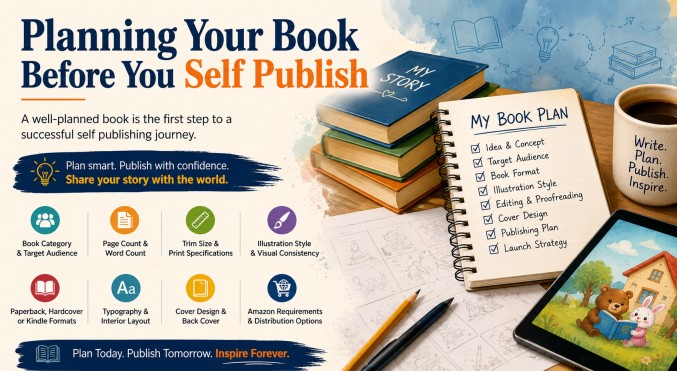
Before any publishing decision matters, your manuscript needs to be genuinely ready. Developmental editing, copyediting, and proofreading should be treated as separate stages rather than one general correction pass.
Uploading an unfinished or poorly edited manuscript is one of the most common reasons self-published books receive weak reviews. The manuscript should be finalized before cover-spine calculations, interior formatting, and print-ready files are completed.
Choosing between paperback, hardcover, and ebook is usually one of the first concrete self-publishing decisions. It affects trim size, page-count planning, cover specifications, printing costs, retail pricing, and distribution.
For many novels, memoirs, and general nonfiction books, paperback and ebook are practical first formats. Hardcover may be more important for children's picture books, gift books, art books, photography collections, and premium titles.
Amazon KDP, IngramSpark, Blurb, Lulu, and Draft2Digital serve different publishing and distribution needs. They are not interchangeable, and many authors use more than one platform for different formats or sales channels.
KDP is closely connected to Amazon sales, while IngramSpark is commonly used for wider print distribution. Blurb may suit photography and art books, while Draft2Digital is commonly associated with ebook and print distribution across multiple retailers.
Self-publishing costs vary depending on the type of book, manuscript length, number of illustrations, formats, editing needs, design complexity, and how much work the author completes independently.
A publishing budget may include editing, illustration, cover design, interior formatting, ISBNs, proof copies, printing, distribution, and promotion. Authors should estimate these costs before production begins so that format, pricing, and service decisions remain realistic.
An ISBN is not required in exactly the same way for every platform or format, but it affects how a book is identified, tracked, distributed, and displayed in publishing databases.
Authors should also prepare consistent publishing information, including the author name, title, subtitle, edition, imprint, publication date, book description, categories, and other metadata required by the selected platform.
A self-published book needs files that meet the technical requirements of the chosen publishing platform. The cover must match the exact trim size, page count, spine width, bleed, and binding specifications. The interior must also meet the platform's margin, bleed, image-resolution, font, and page-layout requirements.
Cover design, interior design, typography, and illustration are important parts of production, but they involve their own detailed creative and technical decisions.
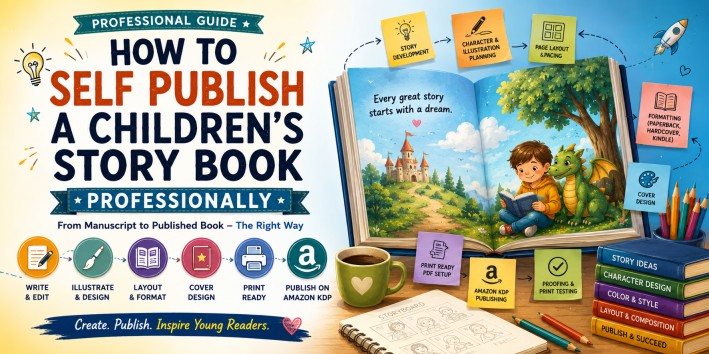
Children’s books, picture books, educational books, and other illustrated titles require additional planning because the words, artwork, typography, and page layout must work together as one complete reading experience.
Before final illustrations begin, authors should decide how the manuscript will be divided across the pages. Page planning helps determine where scenes change, where text will appear, and whether each part of the story requires a full-page illustration, spot illustration, or double-page spread.
Picture books depend heavily on visual pacing. Every page turn can introduce a new idea, reveal an important moment, create humor, or build suspense. For this reason, the manuscript should normally be finalized before detailed sketches, final illustrations, and interior formatting begin.
Important production considerations for illustrated books include:
Authors should also review the completed illustrations at the intended printed size. Fine details, small text, light colors, and elements positioned near the trim line may look acceptable on a large computer screen but reproduce differently in the finished book.
Once the files are ready, the author uploads the interior and cover, enters the book metadata, selects territories, chooses pricing, and reviews the platform's digital preview.
Publishing itself is largely mechanical, but small mistakes can cause rejected files, incorrect cropping, unreadable text, misplaced spine elements, or inconsistent product listings.
A digital preview can reveal basic layout problems, but it cannot show exactly how the finished book will look and feel in print. Authors should review a physical proof before approving the book for sale.
Check the image brightness, margins, text size, page order, spine alignment, cover placement, paper appearance, cropping, bleed, and overall print quality.
Paperback and hardcover editions should be reviewed separately because their binding, cover construction, spine width, and interior presentation can differ.
Making a book available on Amazon is different from making it available to bookstores, libraries, schools, independent retailers, and international buyers.
Distribution decisions may involve wholesale discounts, return settings, territories, print-on-demand networks, direct sales, retailer availability, and the use of multiple publishing platforms.
A book going live is not the same as a book selling. Authors should prepare the book description, categories, keywords, author information, advance copies, review strategy, and launch plan before the publication date.
Marketing is part of the self-publishing journey, but detailed promotion strategies belong in a separate marketing cluster.
Self-publishing is one of several possible publishing paths. Authors may also consider traditional publishing, hybrid publishing, assisted self-publishing, or publishing-service companies.
Before working with any company, authors should understand what rights they retain, what services are included, how royalties are calculated, who controls the publishing account, and whether the agreement limits future use of the manuscript or files.
Rushing into publication before editing and proofreading are complete can lead to expensive corrections and negative reader reviews.
Paperback, hardcover, and ebook editions can require different cover files, dimensions, margins, and layout decisions. Format planning should happen before final file preparation.
The retail price should be chosen only after reviewing the printing cost and expected royalty. A book can be priced too low to earn a meaningful royalty or too high for its intended readers.
A file made for one trim size, page count, or binding type may not work for another edition. Each format should be checked against its current publishing specifications.
Files that appear correct on a screen may reveal problems when printed. Cropping, margins, color, spine alignment, image placement, and text size should be checked in a physical copy.
Publishing makes the book available, but it does not automatically create visibility or demand. Authors need a realistic strategy for reaching readers and collecting reviews.
If you are early in the process, begin by completing the manuscript, choosing the intended book formats, and selecting the likely publishing platform. These decisions determine technical specifications that may be expensive to change later.
If the manuscript is already edited, move next to ISBN planning, trim size, pricing, cover preparation, interior formatting, and proof-copy review.
Yes. Authors can independently publish fiction, nonfiction, children's books, memoirs, poetry, educational books, workbooks, and many other types of content.
Some platforms do not charge a large fee simply to upload a book. However, professional editing, design, illustration, formatting, ISBNs, proofs, and promotion may involve costs.
The cost depends on manuscript length, editing needs, illustrations, formats, page count, design complexity, and how much work the author completes independently.
The requirement depends on the format, platform, and distribution plan. Some platforms provide free ISBNs for print editions, while authors may choose to obtain their own ISBNs.
The best platform depends on whether your priority is Amazon sales, bookstore and library distribution, high-quality art-book printing, ebook distribution, or a combination of these goals.
Paperback and ebook are practical first formats for many text-driven books. Hardcover may be more important for picture books, gift books, art books, and premium titles.
The timeline depends on the amount of editing, design, illustration, revision, file preparation, proofing, and platform review required.
It can be made available through distribution systems used by bookstores and libraries, but availability does not guarantee that an individual store or institution will order it.
Authors generally retain ownership of their work, but they should carefully review the terms of every platform, distributor, and service provider they use.
Self-publishing is not a single upload or one-time decision. It is a complete process that begins with a finished manuscript and continues through format selection, platform choice, ISBN planning, pricing, file preparation, proofing, distribution, publication, and promotion.
Authors who understand how these stages connect are better prepared to avoid unnecessary redesign costs, pricing problems, inconsistent editions, rejected files, and rushed publication decisions.
Whether you are preparing a novel, memoir, nonfiction title, illustrated book, or children's picture book, the most effective approach is to make each publishing decision in the correct order and use professional support where it adds meaningful value.
Blueberry Illustrations works with authors worldwide on book illustration, cover preparation, interior formatting, ebook conversion, paperback and hardcover publishing, and distribution support.
