Our Happy
Authors


Popular Illustration Styles, Characteristics & Examples
Children’s book illustrations do much more than decorate a story. They help young readers understand characters, follow the action, recognize emotions, and imagine the world the author has created. The right illustration style can also establish the mood of a book before a child reads the first line.
There are many types of children’s book illustrations, from playful cartoon and whimsical artwork to watercolor, realistic, semi-realistic, minimalist, and digital styles. Each has different visual characteristics and works particularly well for certain age groups, genres, and types of stories.
For authors, choosing an illustration style is not simply a matter of deciding which artwork looks attractive. A simple, colorful cartoon style may work beautifully for an early reader, while a magical story may benefit from whimsical or fantasy illustrations. Educational books may require clearer or more realistic artwork, while an emotional picture book might be especially suited to soft watercolor or hand-drawn illustrations.
In this guide, we’ll explore children’s book illustrations in three practical ways:
Understanding these differences will help you compare illustration styles, identify what suits your story and audience, and communicate your visual direction more clearly when working with a children’s book illustrator.
The medium used to create an illustration influences its texture, color, level of detail, and overall visual character. In children’s books, illustrations are generally created using traditional handmade techniques, digital tools, or a combination of both. Watercolor can create a soft and expressive look, pencil and ink can emphasize line and detail, while digital painting and vector artwork offer flexibility and consistency. Understanding these differences can help authors choose a medium that complements the story, target age group, and desired illustration style.
Manual or handmade illustrations are created using traditional art materials such as watercolor, pencil, ink, gouache, acrylic, pastels, or mixed media. Their visible brushstrokes, paper textures, variations in line, and natural color transitions can give children’s book artwork a warm and distinctive character. Traditional techniques are particularly well suited to stories where atmosphere, emotion, texture, or a handcrafted appearance is important.
Tip for Authors: Choose handmade illustration when texture, atmosphere, and an organic artistic quality are important to your story. Watercolor may suit a gentle or whimsical picture book, while ink can work beautifully for detailed line art and gouache or acrylic can provide stronger, more vibrant colors. The best medium is the one that supports the mood and storytelling rather than simply following a particular trend.
Digital illustrations are created using drawing and painting software such as Adobe Photoshop, Illustrator, Procreate, and similar tools. They can range from simple vector artwork and flat cartoon styles to richly textured digital paintings that resemble watercolor, gouache, or other traditional media. Digital illustration is widely used in children’s books because it allows artists to combine creative freedom with precise control over color, composition, character design, and detail.
For illustrated books with recurring characters, digital artwork can be especially useful because colors, proportions, clothing, expressions, and other visual details can be referenced throughout the project. This helps create a consistent visual world across full-page illustrations, double-page spreads, spot illustrations, and cover artwork.
Tip for Authors: Digital illustration does not describe one particular visual style. A digital children’s book can look like a simple cartoon, a soft watercolor painting, a detailed fantasy scene, or a realistic picture. When choosing digital artwork, focus first on the visual style that suits your story and audience, and then on the technique used to create it.
Digital illustrations can be supplied in different file formats depending on how the artwork will be used. PNG files are useful when an illustration requires a transparent background, while JPEG files are commonly used for flattened full-color artwork. Professional print files may also be prepared in formats such as TIFF, PSD, PDF, or AI depending on the illustration technique and production requirements. GIF is primarily used for simple animation on digital platforms rather than for printed children’s book illustrations.
Children’s book illustrations can also be classified by the role they play within the book. Some illustrations carry much of the storytelling, while others introduce characters, explain information, highlight important moments, or attract attention on the cover. Understanding the purpose of each illustration helps authors decide how much artwork a book needs and how illustrations should work together with the text and page layout.
Picture book illustrations are an essential part of visual storytelling. Rather than simply showing what the text already says, effective illustrations can reveal emotions, actions, settings, relationships, and story details that may not be explained in words. In many picture books, the words and images work together to tell the complete story.
Picture book illustrations can be created in almost any visual style. Cartoon and whimsical illustrations often suit humorous or imaginative stories, while watercolor can create a softer and more emotional atmosphere. Realistic or semi-realistic artwork may work well for stories grounded in real experiences, nature, history, or detailed environments. The best choice depends on the story’s mood, target age group, characters, and intended reading experience.
Imagine a story about a little rabbit discovering a magical garden. A small spot illustration might introduce the rabbit at the beginning, a full-page illustration could show the entrance to the garden, and a double-page spread could reveal the entire magical world at an important moment in the story. Using different illustration formats in this way creates visual variety while helping control the pace of the story.
Tip for Authors: When planning a picture book, think about the complete sequence rather than choosing each illustration independently. Decide which moments deserve full pages or spreads, where smaller illustrations are sufficient, and where text needs space within the composition. A well-planned illustration sequence helps the book feel cohesive and keeps the visual storytelling moving from beginning to end.
Educational or instructional illustrations are designed to explain information visually and make new concepts easier for children to understand. They are commonly used in nonfiction books, textbooks, activity books, science books, ABC and counting books, and other learning-focused publications. Unlike illustrations created mainly to establish mood or tell a story, educational artwork prioritizes clarity, accuracy, and easy visual understanding.
In a children’s science book about plants, one illustration might show a clearly labeled flower identifying the petals, stem, leaves, and roots. Another could use a sequence of simple pictures to show how a seed germinates and gradually develops into a plant. The illustrations make information that may be difficult to explain with words alone easier for young readers to understand.
Tip for Authors: For educational books, choose an illustration style that supports the learning objective rather than competing with it. Younger children may respond well to simple shapes, bright colors, and friendly characters, while books for older children can include more detailed and realistic artwork. The most effective educational illustrations balance visual appeal with clarity and accuracy.
Character-focused illustrations place particular emphasis on the appearance, personality, expressions, and actions of the main characters. They are especially important in children’s books because young readers often connect with a story through its characters. A recognizable and expressive character can help communicate emotions, establish personality, and guide readers through the story even when relatively little text is used.
Character consistency is particularly important when the same child, animal, or fantasy character appears across many illustrations. Illustrators often create character reference sheets before completing the final artwork. These may show the character from different angles along with important details such as proportions, clothing, colors, hairstyles, accessories, and facial expressions.
For example, if the main character is a little girl who always wears a red scarf, her facial features, hairstyle, body proportions, clothing, and scarf should remain recognizable whether she is running through a park, sitting at school, or appearing in a completely different setting. Her expressions and poses can change, but her underlying design should remain consistent.
Character-focused illustration is particularly useful for picture books, early readers, chapter books, book series, and stories built around a memorable central character. It can also be important when several recurring characters appear together and readers need to recognize each one easily from page to page.
Tip for Authors: Before illustrating an entire book, establish the appearance of recurring characters clearly. A character sheet showing front, side, and three-quarter views, key expressions, clothing, colors, and important accessories can provide a useful visual reference throughout the project and help maintain consistency from the first illustration to the last.
Cover illustrations are created specifically to introduce the book visually and give readers an immediate sense of its characters, mood, and story. In children’s publishing, the cover often provides the first encounter with the book, so the illustration should be appealing, easy to understand, and appropriate for the intended age group.
A children’s book cover might feature the main character, an important setting, a key relationship, or a scene that captures the overall feeling of the story. For example, an adventure story might show the main character approaching a mysterious forest, while a gentle bedtime story may use a quieter composition with soft colors and a peaceful expression.
Cover and interior illustrations should feel as though they belong to the same book, but they serve different purposes. Interior artwork develops the story across a sequence of pages, while the cover must communicate the book’s identity in a single composition. For this reason, a cover often needs a particularly clear focal point and careful coordination between the illustration and typography.
Tip for Authors: Think of the cover as an introduction to the visual world of the book rather than a summary of the entire story. A strong children’s book cover usually has one clear focal point, recognizable characters, an appropriate mood, and enough space for the title and other essential text.
Sequential illustrations tell a story through a series of connected images, usually arranged in panels. Instead of presenting one scene at a time, sequential art shows actions, reactions, conversations, and changes over several visual moments. This approach is most commonly associated with graphic novels and comics, but it can also appear in illustrated chapter books and children’s books that use panel-based storytelling.
Imagine a young character discovering a mysterious box. The first panel might show the character noticing the box, the second could show a curious expression, the third might show a hand reaching toward it, and the final larger panel could reveal what happens when the box is opened. Breaking the action into several moments creates anticipation and allows the illustrations themselves to control the pace of the scene.
Sequential illustration is particularly well suited to graphic novels, comics, illustrated chapter books, adventure stories, humorous stories, and books where actions and conversations are important parts of the storytelling. Although graphic novels are often associated with middle-grade and young adult readers, sequential storytelling can also be simplified for younger children.
Tip for Authors: When planning sequential illustrations, think in moments rather than simply dividing the text into equal sections. Decide which actions need their own panels, where a reaction deserves emphasis, and which important scene should receive more visual space. Good sequential art guides the reader naturally from one image to the next without making the page difficult to follow.
Clipart illustrations are small, standalone images designed to be placed easily within a page or layout. Unlike full-page story illustrations, clipart usually represents a single character, object, symbol, or decorative element. In children’s publishing, it is most commonly used in educational books, activity books, worksheets, workbooks, and other learning materials rather than as the primary artwork for a narrative picture book.
Clipart illustrations are particularly useful in alphabet and counting books, activity books, educational worksheets, flashcards, classroom materials, puzzles, matching exercises, and other learning-focused publications. For example, an alphabet book might use individual illustrations of an apple, ball, cat, and dog to visually reinforce the letters being introduced.
Clipart and spot illustrations can look similar because both are usually smaller than full-page artwork, but they serve slightly different purposes. A spot illustration is normally created specifically for a particular moment or passage in a book, while clipart is generally a standalone visual element that can be positioned independently within a layout or reused where appropriate.
Tip for Authors: Use clipart when individual objects or characters need to support learning, activities, or page decoration. For a narrative picture book, custom spot, full-page, or double-page illustrations are usually better suited to developing characters, settings, and continuous visual storytelling.
Coloring page illustrations are black-and-white line drawings specifically designed to be colored by the reader. They are commonly used in children’s coloring books, activity books, educational workbooks, and interactive publications. Unlike finished full-color illustrations, coloring artwork relies on clear outlines and well-defined spaces that make the image enjoyable and practical to color.
Coloring illustrations can be used in standalone coloring books as well as activity books, alphabet books, educational workbooks, puzzle books, and interactive storybooks. They may also support learning activities by asking children to color particular letters, numbers, animals, shapes, objects, or parts of a scene.
The appropriate level of detail depends largely on the intended age group. A coloring book for preschool children might feature one large animal or character with bold, uncomplicated outlines, while a book for older children may include more detailed characters, backgrounds, patterns, and complete scenes.
A coloring page for a preschool animal book might show a large smiling elephant with simple outlines and plenty of open space for coloring. For an older child, the same subject could include additional details such as trees, plants, other animals, and a more developed background.
Tip for Authors: When creating a coloring or activity book, consider how the artwork will actually be colored rather than simply converting finished illustrations to black and white. Clear outlines, appropriate spacing, limited shading, and the right level of detail can make the pages easier and more enjoyable for the intended age group.
The illustration style of a children’s book determines its overall visual personality and can strongly influence how readers experience the story. Elements such as line quality, color palette, character design, texture, level of detail, and composition all contribute to the look and mood of the artwork. A playful cartoon style may make a story feel humorous and energetic, while whimsical illustrations can create a magical and imaginative atmosphere. Realistic and semi-realistic styles can provide greater detail and believability, while minimalist artwork uses simpler shapes and compositions to communicate ideas clearly.
There is no single illustration style that is best for every children’s book. The right choice depends on factors such as the target age group, story genre, emotional tone, setting, characters, and the experience the author wants to create for the reader. Understanding the characteristics of different children’s book illustration styles makes it easier to identify which visual approach will complement your story.
Below, we explore some of the most popular children’s book illustration styles, their defining characteristics, the types of stories they work well for, and examples of how each style can be used.
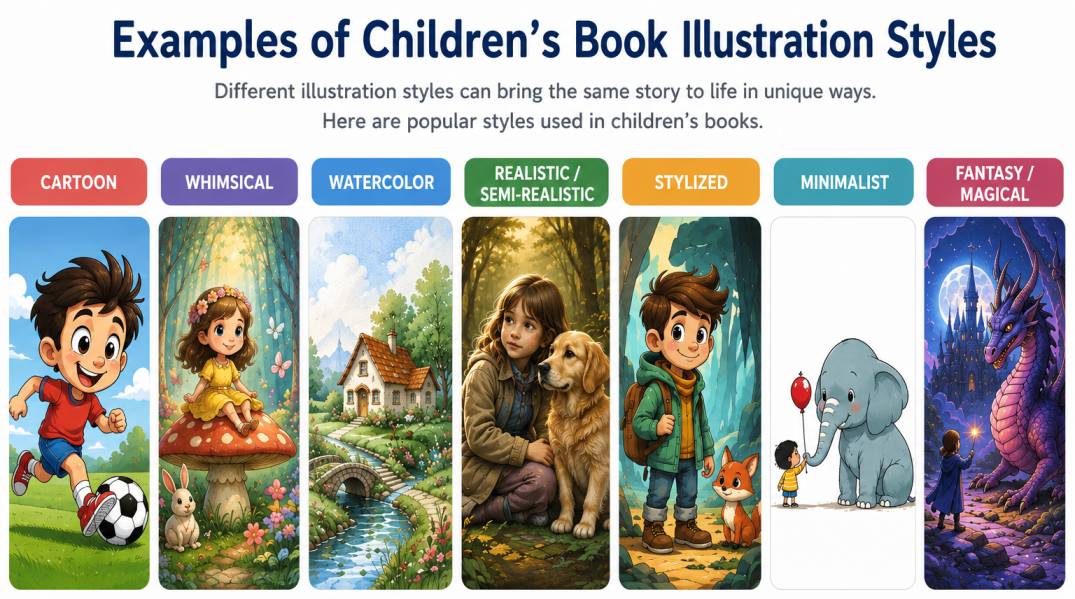
| Illustration Style | Typical Characteristics | Often Suited To |
|---|---|---|
| Cartoon | Simple shapes, expressive faces, exaggerated features | Humorous stories, early readers, animal stories |
| Whimsical | Playful, imaginative, dream-like, unusual details | Fairy tales, bedtime stories, imaginative picture books |
| Realistic | Lifelike proportions, natural details, believable settings | Nonfiction, history, nature, real-life stories |
| Semi-Realistic | Believable proportions with controlled stylization | Family stories, chapter books, historical and fantasy stories |
| Stylized | Distinctive shapes, creative proportions and colors | Picture books, humorous stories, graphic novels |
| Minimalist | Simple forms, limited detail, clean compositions | Board books, concept books, early readers |
| Fantasy / Magical | Imaginary worlds, magical elements, invented creatures | Fantasy adventures, fairy tales, myths and legends |
Cartoon illustrations use simplified shapes, expressive characters, and exaggerated features to create artwork that is lively, easy to understand, and visually engaging. This is one of the most versatile children’s book illustration styles and can range from very simple artwork for young children to more detailed cartoon scenes for older readers.
Cartoon illustrations work particularly well for humorous picture books, early readers, animal stories, adventure stories, educational books, comics, and character-driven stories. Because emotions and actions can be communicated very clearly, cartoon artwork is especially effective when the story depends on humor, personality, or playful interactions between characters.
A mischievous monkey with large expressive eyes, an exaggerated grin, and energetic poses can immediately communicate a playful personality. As the monkey jumps between trees, hides behind leaves, or reacts dramatically to other characters, exaggerated expressions and body language can help young readers understand both the action and emotion of the scene.
Tip for Authors: “Cartoon” describes a broad family of illustration styles rather than one specific look. When selecting a cartoon style, consider how simple or detailed the characters should be, how exaggerated their features and expressions should appear, and whether the overall mood should feel humorous, gentle, adventurous, or energetic. Establishing these characteristics early also helps maintain a consistent visual style throughout the book.
Whimsical illustrations create a playful, imaginative, and sometimes magical visual world. This children’s book illustration style often combines expressive characters, unusual details, imaginative environments, and a sense of wonder. Unlike realistic artwork, whimsical illustration does not need to follow the rules of the real world, giving illustrators freedom to exaggerate shapes, colors, proportions, and settings to support the mood of the story.
Whimsical illustrations are particularly well suited to fairy tales, magical adventures, fantasy picture books, bedtime stories, imaginative animal stories, and books built around wonder, curiosity, or make-believe. The style can be adapted for different age groups by changing the amount of detail, color, and complexity in the artwork.
Cartoon and whimsical illustrations can overlap, but they are not exactly the same. Cartoon illustration usually emphasizes simplified characters, clear expressions, humor, and exaggerated actions. Whimsical illustration places greater emphasis on imagination, atmosphere, unusual details, and the creation of a playful or magical story world. A children’s book can also combine both approaches, using cartoon-style characters within a whimsical environment.
Imagine a castle floating among soft clouds where rabbits wear tiny jackets, birds deliver letters, and flowers glow beneath the moon. The characters may be simple and expressive, but the unusual environment and imaginative details give the scene its whimsical quality and establish a magical tone for the story.
Tip for Authors: If you want a whimsical illustration style, describe the feeling you want the artwork to create rather than simply asking for it to look “whimsical.” Consider whether your story should feel magical, dreamy, playful, quirky, gentle, or adventurous, and decide how much fantasy and visual detail should appear in the illustrations. This gives the illustrator a clearer direction for developing a consistent visual world.
Realistic illustrations depict people, animals, objects, and environments with lifelike proportions, recognizable details, and believable forms. In children’s books, realistic artwork does not necessarily need to look exactly like a photograph; instead, it aims to represent the real world accurately enough for characters, settings, and subjects to feel natural and convincing.
Realistic illustrations work particularly well for educational books, nonfiction, biographies, historical stories, nature books, science books, culturally specific stories, and picture books based on real-life experiences. They can be especially useful when readers need to recognize real animals, environments, objects, clothing, or events accurately.
The main difference is the degree of visual simplification and exaggeration. Cartoon illustrations may enlarge eyes, simplify anatomy, exaggerate expressions, or alter proportions for personality and humor. Realistic illustrations stay closer to natural proportions and recognizable real-world details. Both styles can be expressive, but they create very different visual experiences.
In a children’s story about planting trees, a realistic illustration might show children working in a park with believable body proportions, recognizable gardening tools, accurately drawn plants, natural clothing, and a detailed outdoor environment. These visual details can support the story while also helping children understand what the activity looks like in real life.
Tip for Authors: Decide how much realism your story actually needs. Some books benefit from highly detailed, lifelike artwork, while others need only realistic proportions and recognizable environments combined with softer, more child-friendly characters. Providing clear visual references can help the illustrator establish the appropriate level of realism and maintain it throughout the book.
Semi-realistic illustrations combine believable proportions and recognizable real-world details with a degree of artistic stylization. Characters may have natural anatomy and convincing environments while still using slightly exaggerated expressions, simplified details, enhanced colors, or more expressive features. This balance allows the artwork to feel believable without being restricted by strict realism.
Semi-realistic illustrations work particularly well for illustrated chapter books, middle-grade stories, fantasy adventures, historical fiction, family stories, educational books, and picture books that need believable characters without a completely realistic appearance. The style can also work well when a story combines everyday settings with imaginative or magical elements.
Realistic illustration stays relatively close to natural anatomy, proportions, textures, lighting, and real-world details. Semi-realistic illustration keeps enough of these qualities to make the subject believable but gives the artist greater freedom to simplify or exaggerate selected features. For example, a semi-realistic child might have natural body proportions but slightly larger eyes and more expressive facial features than a realistically illustrated child.
Imagine a young hero exploring a misty forest. The character might have believable anatomy, clothing, and body proportions, while slightly enhanced facial expressions communicate curiosity or fear. The trees and landscape may appear realistic, but dramatic lighting, richer colors, and subtle fantasy details can create a more imaginative atmosphere.
Tip for Authors: “Semi-realistic” can describe a wide range of visual approaches, so visual references are particularly helpful when requesting this style. Identify which elements should remain realistic and which can be stylized—for example, realistic body proportions with slightly larger eyes, or realistic environments with softer textures and more expressive colors. This gives the illustrator a much clearer visual direction.
Stylized illustrations intentionally change or simplify real-world forms to create a distinctive artistic look. Instead of following realistic proportions, colors, shapes, or perspective, the illustrator develops a consistent visual language that reflects the personality and mood of the story. Characters might have elongated bodies, geometric features, unusually shaped heads, simplified facial details, or exaggerated proportions, while environments may use imaginative shapes, perspectives, and color combinations.
Stylized illustrations work particularly well for picture books, imaginative stories, graphic novels, fantasy books, humorous stories, and books that need a distinctive visual identity. They can also be effective for stories in which personality and artistic expression are more important than realistic representation.
Semi-realistic illustration begins with believable proportions and real-world details and then introduces a controlled amount of artistic simplification or exaggeration. Stylized illustration gives the artist considerably more freedom to reshape characters, objects, colors, and environments according to a chosen visual concept. A stylized character, for example, might have a very large head, extremely thin limbs, geometric features, or proportions that would never occur naturally.
A stylized city scene might feature tall, narrow buildings leaning at playful angles, oversized windows, curved streets, unusually shaped cars, and an imaginative color palette. The city is still recognizable, but its forms have been deliberately altered to create a distinctive story world rather than reproduce a real city accurately.
Tip for Authors: When requesting a stylized illustration style, visual references are more useful than simply asking for something “unique.” Consider the shapes, proportions, line quality, colors, textures, and level of exaggeration you prefer. Once a visual direction is established, those same design principles should remain consistent across the characters and environments throughout the book.
Minimalist illustrations use simple shapes, clean lines, limited details, and carefully planned compositions to communicate an idea with as few visual elements as necessary. Rather than filling every part of the page, this children’s book illustration style often uses open space and a clear focal point to direct attention toward the character, action, or emotion that matters most.
Minimalist illustrations can work particularly well for board books, early readers, concept books, educational books, modern picture books, and stories where a simple visual presentation supports the narrative. The style can be especially effective for younger readers when the author wants attention to remain focused on one character, object, emotion, or action at a time.
Minimalist and simple cartoon illustrations can look similar, but they describe different aspects of the artwork. Cartoon illustration primarily refers to how characters and objects are represented, often using simplified or exaggerated features. Minimalism refers more broadly to reducing visual elements, details, colors, and compositional complexity. A book can therefore use cartoon-style characters within a minimalist overall design.
A minimalist illustration of a child flying a kite might show the child, the kite, a few simple clouds, and a large open sky. Clean shapes and a limited color palette keep attention on the movement of the kite and the child’s expression without requiring a highly detailed background.
Tip for Authors: Minimalist does not simply mean “less artwork.” Effective minimalist illustration carefully chooses which visual elements are necessary and removes those that do not contribute to the story. When planning this style, identify the characters, actions, objects, and emotions that must receive the reader’s attention on each page.
Fantasy and magical illustrations depict worlds, characters, creatures, or events that go beyond ordinary reality. They may feature dragons, fairies, unicorns, magical powers, enchanted forests, imaginary kingdoms, floating islands, or other supernatural elements. Fantasy illustration is defined mainly by its subject matter and world-building, so the artwork itself can be realistic, semi-realistic, cartoon, whimsical, or highly stylized.
Fantasy and magical illustrations work particularly well for fairy tales, magical adventures, fantasy picture books, illustrated chapter books, middle-grade fantasy, graphic novels, myths, legends, and stories involving imaginary worlds or supernatural events. The level of detail and intensity can be adjusted according to the age of the intended reader.
Fantasy and whimsical illustrations often overlap, but they are not exactly the same. Fantasy primarily describes subject matter involving magic, imaginary creatures, supernatural events, or invented worlds. Whimsical describes the playful, curious, dream-like, or imaginative feeling of the artwork. A fantasy illustration can therefore be whimsical, dark, realistic, dramatic, humorous, or highly detailed depending on the story.
A young wizard standing in a moonlit forest might cast a glowing spell while small mythical creatures watch from behind the trees. Magical plants, unusual light, and distant castle towers can establish a world that clearly operates beyond ordinary reality while also providing clues about the larger story.
Tip for Authors: Good fantasy illustration requires more than adding magical objects to a scene. Think about how the entire fictional world works—its environments, creatures, clothing, architecture, colors, and magical elements. Establishing these details early helps the illustrations feel as though they belong to one believable and consistent imaginary world.
Choosing the right illustration style is about finding the visual approach that best supports your story, characters, audience, and mood. A style may look beautiful on its own but still be wrong for a particular book. Before deciding, consider how the artwork needs to communicate emotion, action, setting, and information throughout the complete story.
Start with the feeling you want readers to experience. A humorous story may work well with expressive cartoon illustrations, while a fairy tale or magical adventure may benefit from whimsical or fantasy artwork. A story based on real experiences might suit realistic or semi-realistic illustrations, while a quiet, emotional picture book could work beautifully with soft watercolor or understated artwork.
The target age group can influence the amount of detail, complexity, and visual information that works well on each page. Books for toddlers and preschoolers often benefit from clear characters, recognizable shapes, expressive emotions, and relatively simple compositions. Older children can generally follow more detailed environments, complex compositions, subtle expressions, and sophisticated visual storytelling.
Consider how important the characters are to the story and what readers need to understand about them. A character-driven story may require highly expressive faces and body language, while an adventure or fantasy book may need more detailed costumes, environments, creatures, and props. If characters appear repeatedly, choose a style that can be maintained consistently across different poses, expressions, viewpoints, and scenes.
More detail is not automatically better. Some stories benefit from richly developed backgrounds filled with objects for children to discover, while others are stronger with simple compositions that keep attention on one character or action. The level of detail should support the storytelling rather than distract from it.
Think about how the artwork will actually appear throughout the book. A picture book containing large double-page spreads may allow for detailed environments and multiple characters, while a book using smaller spot illustrations may require simpler compositions and clearly recognizable subjects. The trim size, page layout, and amount of text also influence how much visual detail can be used effectively.
If you are unsure which style to choose, imagine the same important scene illustrated in several different ways. A forest scene, for example, could appear playful in a cartoon style, dreamy in watercolor, magical in a whimsical style, believable in semi-realistic artwork, or dramatic in detailed fantasy illustration. Comparing approaches in this way can make it easier to identify which visual direction feels most appropriate for your story.
Collect examples that represent qualities you like, such as character proportions, expressions, color palettes, line work, textures, backgrounds, or level of detail. References do not need to represent one exact style; they can help communicate different aspects of the visual direction you have in mind. An illustrator can then use that information to develop an original approach appropriate for your book.
A successful illustration style needs to work across many different scenes, not just one attractive image. Consider whether the same characters can remain recognizable in different locations, emotions, poses, clothing, and lighting conditions. Colors, line work, proportions, and the level of detail should also remain visually cohesive from the beginning of the book to the end.
Tip for Authors: You do not need to know the technical name of an illustration style before approaching an illustrator. It is often more useful to describe the mood, audience, characters, level of realism, colors, and visual qualities you want. A professional children’s book illustrator can use these preferences and your manuscript to help develop a suitable visual direction.
Once you have an idea of the illustration style that suits your story, the next step is turning that visual direction into a consistent set of illustrations. A professional children’s book illustrator can help develop the characters, establish the color palette and visual style, plan important scenes, and maintain consistency throughout the book.
Before beginning a complete illustration project, it is helpful to discuss the manuscript, target age group, preferred illustration style, character details, book size, number of illustrations, and whether the artwork will include full-page scenes, double-page spreads, or smaller spot illustrations. Many professional projects begin with character development or sample artwork before moving into the complete book.
At Blueberry Illustrations, we create custom children’s book illustrations in a wide range of styles and guide authors through character development, sketches, revisions, final color artwork, and book-ready illustrations.
Children’s book illustration continues to evolve as artists combine traditional techniques, digital tools, distinctive character design, and new approaches to visual storytelling. While choosing a style simply because it is fashionable is rarely a good idea, understanding popular illustration trends can help authors explore different possibilities for presenting their stories.
Many illustrators combine traditional materials with digital techniques. Artwork may begin with pencil, ink, watercolor, gouache, or another handmade medium and then be scanned for digital coloring, editing, composition, or finishing. This approach can preserve organic textures while providing the flexibility of a digital workflow.
Children’s book characters increasingly use recognizable silhouettes, expressive faces, distinctive proportions, and memorable visual details. Rather than making every character highly detailed, illustrators may focus on a few defining features that communicate personality and help the character remain recognizable throughout the story.
Children’s books can portray characters from a wide range of cultures, backgrounds, abilities, communities, and family experiences. When a story represents a particular culture, place, historical period, or lived experience, thoughtful visual research can help ensure that clothing, environments, objects, and other important details are represented appropriately and consistently.
Digital children’s book artwork does not have to look perfectly smooth or computer-generated. Illustrators can use textured brushes, layered colors, irregular lines, and other techniques to create digital artwork with the visual warmth of pencil, watercolor, pastel, gouache, or other traditional media.
Clean compositions, stylized characters, limited color palettes, and carefully used negative space continue to provide effective options for children’s books. These approaches can create a distinctive visual identity while keeping attention focused on important characters, emotions, and actions.
At the other end of the visual spectrum, fantasy and adventure books can use richly developed environments filled with imaginative details for children to discover. Magical landscapes, unusual architecture, invented creatures, and carefully designed objects can make the setting itself an important part of the storytelling.
Tip for Authors: Trends can provide inspiration, but the best illustration style is the one that serves your particular story. A visual approach should suit the characters, age group, mood, and storytelling needs of the book rather than being selected only because it is currently popular.
1. What are the main types of illustrations used in children’s books?
Children’s book illustrations can be classified by medium, purpose, and visual style. Common mediums include watercolor, pencil, ink, gouache, and digital illustration. By purpose, illustrations may include full-page scenes, double-page spreads, spot illustrations, character-focused artwork, educational illustrations, cover illustrations, sequential art, clipart, and coloring pages. Popular visual styles include cartoon, whimsical, realistic, semi-realistic, stylized, minimalist, and fantasy illustration.
2. What are the most popular children’s book illustration styles?
Popular children’s book illustration styles include cartoon, whimsical, watercolor, realistic, semi-realistic, stylized, minimalist, and fantasy artwork. Some books also combine styles, such as cartoon characters with whimsical environments or semi-realistic characters with fantasy settings. The right style depends on the story, target age group, mood, characters, and desired reading experience.
3. What are the characteristics of a good children’s book illustration style?
A good children’s book illustration style should be visually clear, appropriate for the intended age group, expressive, and consistent throughout the book. Characters should remain recognizable from page to page, while colors, line work, proportions, backgrounds, and level of detail should support the mood and storytelling. The illustrations should complement the text rather than simply repeat it.
4. What is a whimsical children’s book illustration style?
Whimsical illustration is a playful and imaginative style that often uses unusual characters, creative proportions, dream-like settings, expressive colors, and unexpected visual details. It is commonly used for fairy tales, magical adventures, imaginative picture books, and stories designed to create a sense of curiosity and wonder.
5. What is the difference between cartoon and whimsical illustrations?
Cartoon illustrations generally emphasize simplified shapes, exaggerated expressions, clear actions, and playful character designs. Whimsical illustrations focus more on imagination, atmosphere, unusual details, and dream-like or magical environments. The two styles can overlap, and a children’s book may use cartoon-style characters within a whimsical story world.
6. What is the difference between realistic and semi-realistic illustrations?
Realistic illustrations stay relatively close to natural anatomy, proportions, lighting, textures, and real-world details. Semi-realistic illustrations maintain a believable foundation but allow greater artistic freedom, such as slightly larger eyes, simplified features, enhanced colors, or more expressive character designs. Semi-realistic artwork therefore falls between strict realism and more heavily stylized illustration.
7. Which illustration style is best for a children’s picture book?
There is no single illustration style that is best for every picture book. Cartoon and whimsical styles can work well for playful or imaginative stories, watercolor can create a gentle or emotional atmosphere, realistic and semi-realistic artwork can suit real-world subjects, and fantasy illustration can support magical adventures. The best choice is the style that matches the story’s mood, characters, age group, and visual storytelling needs.
8. Are digital illustrations suitable for children’s books?
Yes. Digital illustration is widely used for children’s books and can produce many different visual styles, including cartoon, watercolor-inspired, realistic, semi-realistic, minimalist, and fantasy artwork. Digital tools also make it easier to manage colors, character references, layers, dimensions, and revisions throughout a book illustration project.
9. How do I choose an illustration style for my children’s book?
Start by considering your target age group, story genre, emotional tone, characters, setting, and desired level of detail. Collect visual references showing qualities you like, such as character proportions, colors, textures, expressions, or backgrounds. Comparing the same scene in several different styles can also help you determine which visual direction best supports your story.
10. Can different illustration styles be combined in one children’s book?
Yes, compatible approaches can be combined when they follow a consistent visual direction. For example, a book might use cartoon-style characters, whimsical environments, and watercolor-inspired digital textures. The important consideration is consistency: the characters, colors, line work, proportions, and overall artistic approach should still make the book feel visually cohesive.
Children’s book illustrations are an essential part of visual storytelling. They help establish characters, communicate emotions, develop settings, explain ideas, and guide young readers through the story. Understanding the differences between illustration mediums, purposes, and visual styles can help authors make more confident creative decisions before artwork begins.
From handmade watercolor and pencil artwork to digital painting, cartoon, whimsical, realistic, semi-realistic, stylized, minimalist, and fantasy illustrations, each approach creates a different reading experience. The best illustration style is not simply the one that looks most attractive—it is the one that complements the story, suits the target age group, supports the intended mood, and can remain visually consistent throughout the book.
Before choosing a style, consider your characters, setting, genre, level of detail, color palette, book format, and the emotions you want the illustrations to communicate. Sharing these ideas along with visual references can help your illustrator develop an original and cohesive direction for the complete book.
At Blueberry Illustrations, we create custom children’s book illustrations in a wide range of styles, from playful cartoon and whimsical artwork to watercolor, realistic, semi-realistic, and detailed fantasy illustrations. Our team can help you develop characters, plan story scenes, create consistent artwork, and prepare illustrations for your complete book.
Not sure which illustration style is right for your story? Share your manuscript or project idea with us, and we can help you explore a visual direction that suits your characters, audience, and story.
