Our Happy
Authors


Everything Children's Book Authors Need to Know, Start to Finish
Publishing a children's book involves decisions a standard novel never requires -- how illustrations pace across a spread, which age group your vocabulary should target, how full-bleed artwork needs to be prepared for print. This guide focuses specifically on those children's-book decisions. If you want the full general self-publishing process -- platforms, ISBNs, royalties, and distribution -- start with our complete guide to self-publishing and come back here for the parts that are unique to illustrated children's books.
From first idea to a book in readers' hands -- this is the path every children's book follows, and it's the shape this guide is organized around.
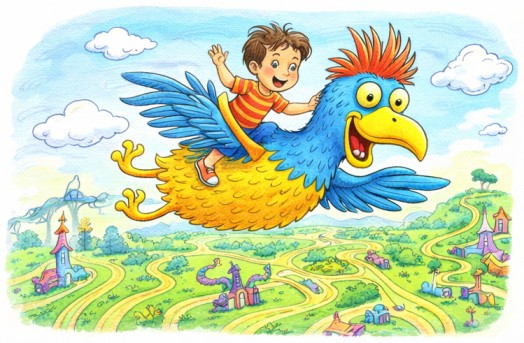
Choosing the correct age group is one of the most important steps when learning how to publish children’s story books. The target reader affects the writing style, vocabulary, illustration detail, page count, typography, and even the final book size.
Many new authors begin with a story idea but do not clearly define who the book is for. This can make the story feel too simple for older children or too complex for younger readers.
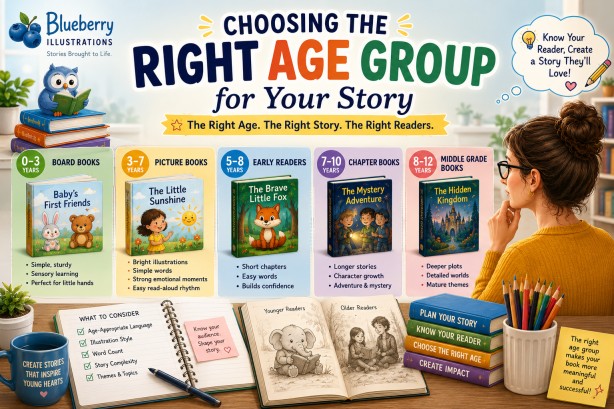
| Age Group | Typical Range | What Changes |
|---|---|---|
| Board Books | 0-3 | Minimal text, high-contrast simple illustrations, durable format |
| Picture Books | 3-7 | One illustration per spread, short sentences, strong visual storytelling |
| Early Readers | 5-8 | More text, simpler illustrations, larger typography for new readers |
| Chapter / Middle Grade | 7-12 | Text-driven, fewer illustrations, deeper plot and character development |
The age group you choose affects much more than the reading level. It influences the length of your manuscript, illustration style, page count, vocabulary, and even the overall design of the book.
Typical Features of Picture Books (Ages 3–7)
Books written for older children generally contain more text, deeper character development, longer story arcs, and fewer illustrations. If you're publishing an early reader, chapter book, or middle-grade novel, you'll spend more time developing the plot, pacing, and chapter structure than designing illustrated page spreads.
How Age Group Influences Illustration Style
The target age also determines the visual style of the illustrations. Professional children's book illustrators adjust their artwork to match the developmental stage and interests of the intended reader.
Books for Younger Children Often Feature:
Books for Older Readers Often Feature:
Choosing your target age group before writing, illustrating, or formatting your book helps ensure every creative decision—from vocabulary and page layout to illustration style—works together to create the best reading experience for your audience.
Children's books demand a different craft than adult fiction: shorter attention spans, heavier reliance on visual storytelling, and page-turn pacing that must work in coordination with the illustrations. For a full breakdown of story-writing craft, see our guide to writing a children's book. The publishing-specific considerations are:
A children's book should match both the intended age group and the reader's ability. While parents often choose books based on the recommended age, schools and libraries may also consider the reading level before adding a title to their collections.
Understanding Reading Levels
Practical Tips
Thinking about reading level during the writing and editing stage helps create a book that is enjoyable, accessible, and appropriate for its intended audience.
The illustrations are often what children notice first, making the illustrator one of the most important creative partners in your publishing journey. A skilled children's book illustrator does much more than create attractive artwork—they help tell the story, express emotions, guide the reader's attention, and bring characters to life in ways that words alone cannot.
If you'd like to learn more about the role illustrations play in children's books, read our guide on what a children's book illustrator does.
Ways to Illustrate Your Children's Book
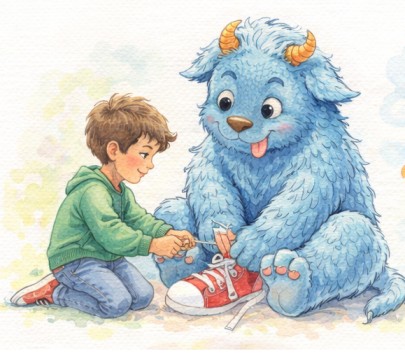
Choosing the right illustrator is one of the most important decisions you'll make. Whether you work with a freelance illustrator, an illustration studio, become an author-illustrator, or use an AI-assisted workflow with professional art direction, look for experience with children's books, consistent artwork, clear communication, and strong visual storytelling.
For practical advice on reviewing portfolios, asking the right questions, understanding contracts, and selecting the best illustrator for your project, see our complete guide to hiring a children's book illustrator.
If you're considering AI-generated artwork, we've also compared the advantages, limitations, costs, and quality considerations in our guide to AI vs. Human Illustrators for Children's Books.
Whichever option you choose, make sure you clearly understand who owns the finished artwork and what usage rights are included before signing an illustration agreement. Learn more about protecting your artwork and publishing rights in our guide to copyright ownership in self-publishing.
Once your manuscript, illustrations, and page layout are complete, your files must be prepared according to the technical requirements of your chosen publishing platform. These requirements vary between services and include topics such as trim size, bleed, image resolution, colour settings, cover templates, and acceptable file formats. If you're publishing on Amazon KDP, we've created a dedicated guide covering all of these technical requirements in detail.
Illustrated children's books need different ebook formatting than text-only ebooks. Standard reflowable ebook formatting (where text adapts to screen size) doesn't work well for picture books, since it can separate illustrations from their intended text pairing. Most picture books use fixed-layout ebook formatting instead, which locks text and image placement exactly as designed—closer to a PDF than a standard ebook.
This means picture books typically require two genuinely separate formatting passes: one for the fixed-layout ebook edition and one for print—not a single file adapted for both. Trying to use the same file for every format is one of the most common formatting mistakes and can result in cropped illustrations, misplaced text, or inconsistent page layouts.
Typography choices matter here too. Pair your print and ebook formatting with the accessible font principles covered in the reading level section above, particularly if you're targeting early readers or pursuing a formal reading-level rating.
Because every publishing platform has different file specifications, it's best to prepare your final print and ebook files using that platform's official requirements. If you're publishing through Amazon KDP, our dedicated KDP guide explains the complete file preparation process for illustrated children's books.
Read: Amazon KDP Requirements for Illustrated Children's BooksOnce your illustrations, cover, and interior files are ready, the next step is deciding how your book will be printed, distributed, and made available to readers. The right publishing route depends on the formats you want to offer, your printing budget, and whether you want to reach online buyers, bookstores, schools, or libraries.
Different publishing platforms offer different features, costs, and distribution options. Some specialise in online retail, while others provide wider bookstore and library distribution. Compare their services, printing quality, supported formats, and pricing before making your decision. For a broader comparison of the available options, read our self-publishing platform comparison guide.
If you're planning to publish specifically through Amazon KDP, see our complete guide to Amazon KDP requirements for illustrated children's books.
Although every project is different, most self-published children's books move through the following production stages:
Once your book is complete, the remaining production steps depend on the publishing platform you choose. Amazon KDP, IngramSpark, and other services each have their own upload process, file requirements, and review tools.
Authors publishing through Amazon can find detailed file specifications, preparation instructions, and upload requirements in our Amazon publishing checklist for illustrated children's books.
Once your book is written, illustrated, and formatted, marketing is the next step -- that's covered in full in our dedicated guide: creative marketing and growth ideas for children's book authors.
Many authors choose to publish independently, while others prefer to work with a self-publishing company that can manage editing, illustration, formatting, cover design, and production. There is no single right approach—the best choice depends on your experience, budget, available time, and the level of support you need.
If you decide to work with a publishing company, look for one with proven experience producing children's books rather than general publishing alone. Children's publishing involves coordinating illustrations, page layouts, typography, print preparation, and age-appropriate design, making it more specialized than many other genres.
Before signing any agreement, review the company's portfolio, services, pricing, revision policy, copyright terms, and customer support. Our guide to choosing a self-publishing company explains what to evaluate before making your decision.
Many successful children's books eventually grow into a series. Even if you currently plan to publish only one book, making a few decisions early can save significant time and money if you later create sequels or companion titles.
Planning ahead doesn't mean committing to a series—it simply gives you the flexibility to expand your books in the future while maintaining a consistent and professional look.
Publishing a children's book combines storytelling, visual craft, and technical production in ways few other genres require. Get the age-group decision right early, treat illustration as a genuine creative partnership rather than an afterthought, and proof your print files carefully -- the rest of the general publishing process is covered in full in our complete self-publishing guide.
How do I publish a children's story book?
Define your target age group, write and edit your manuscript, commission age-appropriate illustrations, format the book correctly for picture-book print or Kindle requirements, and publish through a self-publishing platform. For the general step-by-step self-publishing process, see our complete self-publishing guide.
Do I need an illustrator for my children's book?
Illustrations are essential for most children's books, particularly picture books. You can work with a professional illustrator, an illustration studio, or an AI-assisted workflow -- see our dedicated guide comparing these options.
What age groups should I consider when writing a children's book?
Common categories are board books (ages 0-3), picture books (ages 3-7), early readers (ages 5-8), and chapter/middle-grade books (ages 7-12). Your target age affects vocabulary, sentence length, illustration density, and book format.
How is publishing a children's book different from publishing a novel?
Children's books, especially picture books, require tighter coordination between text and illustration, specific print settings for full-bleed artwork, and formatting that differs significantly between print and fixed-layout Kindle editions.
What is a Lexile or AR reading level, and does my book need one?
Lexile and Accelerated Reader (AR) levels are standardized measures schools and libraries use to match books to reader ability. They're not required to self-publish, but having one can make your book more attractive to school and library buyers.
Are some fonts better for young or struggling readers?
Yes. Fonts with wider letter spacing, simple consistent letterforms, and no decorative serifs are generally easier for early and struggling readers, including children with dyslexia.
Should I lock down my character designs before planning a sequel?
Yes. Documenting character model sheets and illustration style from book one makes it significantly cheaper and faster to maintain consistency in a sequel than trying to reverse-engineer the original style later.
To explore more self-publishing tips and resources, click here.
Click here to visit our Home Page.
