Our Happy
Authors


A Comprehensive Guide for Authors
Learning how to publish children's story books has changed significantly with the growth of artificial intelligence. AI tools can now assist authors with story ideas, character concepts, illustrations, and portions of book production that previously required long development processes. For many writers, especially first-time authors, these tools have made publishing more accessible than ever before.
However, creating images quickly and creating a professionally publishable children's book are often very different tasks. Many technical issues begin to appear when AI-generated content moves from individual images into a complete book. Characters may change appearance between pages, visual styles can become inconsistent, text placement areas may be ignored, and print formatting problems often emerge during production.
These issues are not always obvious during early creation stages. They frequently appear later when illustrations, editing, page design, and publishing requirements must work together as a complete reading experience.
For this reason, many authors and publishing professionals increasingly use AI as a supporting tool rather than a replacement for expertise. AI can improve efficiency, but experienced story book illustrators, editing teams, and publishing specialists often help maintain consistency and prevent quality issues that affect the final book.
This article explores how to publish children's story books using AI tools while maintaining professional quality and avoiding the common technical problems that emerge during modern publishing workflows.
Learning how to publish children's story books has changed significantly over the last few years. Historically, authors moved through a long sequence of steps involving manuscript development, illustrator searches, editing rounds, layout preparation, and publishing preparation before a book ever reached readers.
Many of these steps still exist today. What has changed is the arrival of artificial intelligence tools that can assist with portions of the publishing workflow.
AI systems can now generate draft illustrations, suggest story structures, create character concepts, help brainstorm titles, assist with cover ideas, and support early formatting tasks. For many new writers, this has reduced barriers that previously prevented stories from moving beyond notebooks and unfinished documents.
The result is that more first-time authors are entering publishing than at almost any period in independent publishing history.
However, accessibility should not be confused with complete replacement of expertise.
Publishing technology has often created the impression that one tool can replace an entire production process. Desktop publishing software created similar expectations decades ago. Template websites created similar assumptions for web design. AI is creating a similar discussion within book publishing.
Children's books present a unique challenge because they combine several disciplines simultaneously:
AI may assist with some of these areas, but successful children's books rarely emerge from automation alone.
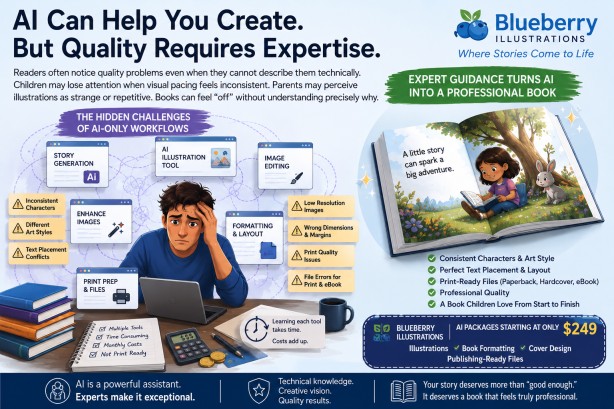
Readers often notice quality problems even when they cannot describe them technically. Children may lose attention when visual pacing feels inconsistent. Parents may perceive illustrations as strange or repetitive. Books can feel "off" without understanding precisely why.
These challenges are not limited to creative quality alone. Modern AI publishing workflows often involve multiple tools rather than a single platform. Authors may use one tool for story generation, another for illustrations, another for image editing, and additional software for formatting and print preparation. Learning how each system works requires time, experimentation, and often ongoing subscription costs.
Even after investing this effort, technical production issues may still emerge later in the process. AI-generated artwork may have inconsistent resolution, incorrect dimensions, weak print quality, text placement conflicts, or file preparation problems for paperback, hardcover, and ebook publishing requirements. A book that looks attractive on a screen may not necessarily meet professional printing standards.
As a result, the challenge for many authors is not simply creating content with AI. The larger challenge is converting AI-generated material into a polished, consistent, and technically publishable book that feels professional from the first page to the last.
In many cases the issue is not the story itself. The issue is that publishing quality depends on hundreds of small decisions made throughout development.
For example, experienced story book illustrators frequently evaluate questions such as:
AI generally does not make these decisions intentionally.
Instead, it predicts visual patterns from training data.
This distinction becomes important when authors attempt to create complete books.
Many successful modern publishing workflows therefore use AI as a production assistant rather than as an independent creator.
Experts increasingly use AI to accelerate repetitive tasks while retaining human oversight for decisions affecting storytelling quality.
This approach allows authors to benefit from faster workflows while reducing the quality issues that often appear when books are generated entirely through automation.
Understanding this balance is becoming one of the most important subjects for anyone learning how to publish children's story books in modern publishing.
Artificial intelligence is often discussed as if it were a complete publishing solution. In reality, AI functions more accurately as a collection of tools that assist with specific tasks rather than replacing the entire publishing process. Understanding this distinction becomes important for authors learning how to publish children's story books because expectations often determine whether a project succeeds or becomes frustrating.
AI can perform certain tasks extremely quickly. It can generate story prompts, suggest titles, create character concepts, produce illustration drafts, help rewrite text, generate background scenes, and assist with organization. Tasks that previously required days of experimentation can sometimes be completed in minutes.
For example, a first-time author creating a picture book about a young rabbit learning friendship could use AI to:
These capabilities can significantly reduce early development time.
However, the ability to generate content should not be confused with understanding publishing decisions.
AI does not naturally understand why a six-year-old reader may respond differently to visual pacing than a ten-year-old reader. It does not intentionally evaluate emotional timing during page turns. It does not independently understand when a scene should feel quieter, more energetic, more dramatic, or visually simpler.
AI predicts patterns based on data. Publishing professionals make decisions based on reader experience.
This difference becomes more visible as projects become larger.
A single illustration generated by AI may appear attractive on its own. Problems often emerge when authors attempt to build twenty or thirty pages around that image. Characters may begin changing appearance. Clothing details may disappear. Background objects may move unexpectedly. Facial expressions may vary from page to page.
Technical issues may also emerge outside creative areas.
Many authors discover that creating content represents only part of the process. Converting generated material into a finished children's book frequently requires editing, visual consistency adjustments, formatting, and publishing preparation.
For this reason, experienced publishing teams increasingly use AI as a production assistant rather than allowing it to control every stage of development. AI can accelerate workflows, but professional oversight often remains important for transforming generated content into a cohesive, technically publishable book.
One common misunderstanding is that AI produces stronger results when asked to create an entire book at once. In practice, many experienced creators use AI in smaller controlled stages.
Instead of generating complete books immediately, workflows often separate production into independent steps:
This process improves control because problems become easier to identify before they affect the entire project.
For example, creating a finalized character reference sheet before scene generation can reduce inconsistencies across pages. Establishing color palettes and visual rules before illustration production may also improve continuity.
Many publishing teams increasingly use structured workflows that combine AI efficiency with professional review stages.At Blueberry Illustrations, for example, AI-assisted projects are supported by expert knowledge of the children's book industry and publishing preparation steps before production begins.
For authors seeking a lower-cost entry point into publishing, Blueberry Illustrations also offers AI-assisted publishing packages starting at only $249, including illustrations, cover design, book inside design, and publishing-ready files.
Children's books are not consumed in the same way as adult books. Young readers often process visual information before reading text, and many children repeatedly revisit illustrations while following the story. Because of this, illustration decisions influence reading behavior itself.
AI-generated illustrations sometimes introduce unnecessary visual complexity because image generation systems frequently optimize for visual richness rather than reading clarity.
Examples may include:
Adults may perceive highly detailed images as impressive, while younger readers may become distracted from the story itself.
Experienced children's publishing professionals frequently simplify scenes intentionally. Illustration quality is not always determined by adding more visual information. In many children's books, reducing visual noise improves storytelling effectiveness.
Many authors recognize visual inconsistency in AI-generated books, but repetition is a different issue that can also affect reader experience.
Image generation systems often recreate similar compositions repeatedly because they predict familiar visual patterns. As a result, books may gradually develop pages that feel visually similar even when the story itself changes.
Examples include:
Professional illustrators often vary scene composition intentionally. Some scenes may appear close to characters, while others show wider environments. Emotional moments may use different perspectives from action scenes.
Variation creates movement through a book. Without this variation, readers may not consciously identify the issue, but the reading experience can gradually feel visually repetitive.
Many AI-generated projects appear complete while being viewed on screens but reveal unexpected issues during final publishing preparation. Authors often assume that once illustrations and text have been generated, the book is ready for publication. In reality, generating content and preparing a book for printing are often very different processes.
One of the most common problems involves image resolution and sharpness. AI-generated illustrations may appear detailed and attractive while viewed on a laptop screen or mobile device, but screens can hide quality issues that become visible during printing.
For example, illustrations may initially appear clear at smaller viewing sizes but lose sharpness when expanded for printed pages. Fine details may become soft, edges can appear less defined, and some images may begin showing visible quality loss after resizing or repeated editing.
These problems frequently become noticeable only during proof preparation or after receiving printed copies. What appears crisp and colorful on a screen may sometimes look flatter or less refined on paper.
AI systems generally focus on creating visually appealing content rather than evaluating whether files satisfy final publishing standards. For this reason, many publishing professionals review image quality, sharpness, and file preparation before books move into production.
In many cases, the final stage is not simply about exporting files. It is often a quality-control process that ensures readers receive a book that looks polished both digitally and in print.
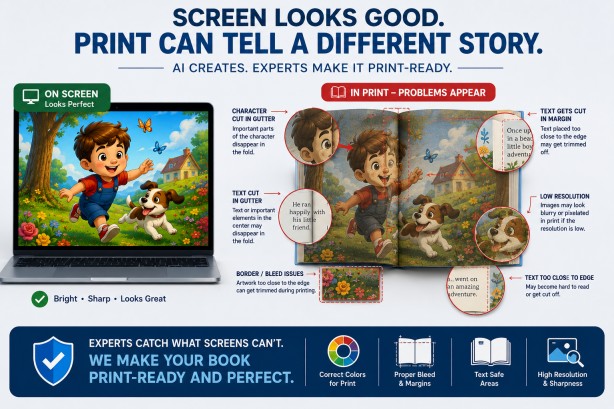
Many authors assume that if a book appears visually correct on a computer screen, it is ready for publishing. However, publishing platforms evaluate books using technical requirements that extend beyond appearance alone.
A file may look completely acceptable during review and still create problems during upload preparation.
Publishing systems frequently evaluate factors such as:
Authors are often surprised because these issues may not appear during content creation stages. A cover may look correctly aligned until spine calculations are applied. Text that appears comfortable on a screen may become too close to page edges after preparation. Similarly, illustrations may look sharp digitally but fail quality checks when prepared for larger printed formats.
The challenge is that AI systems generally optimize for visual output rather than publishing requirements. As a result, attractive generated content does not automatically become publishing-ready content.
For many authors, the difference between a successful upload and a frustrating publishing experience frequently involves adjustments that readers never notice but publishing systems evaluate immediately.
Many first-time authors approach AI as a direct content generator. They often begin by requesting illustrations, scenes, and story elements immediately and then attempt to fix inconsistencies later.
Professional workflows frequently operate differently.
Rather than generating large amounts of content immediately, experienced creators often establish rules before production begins.
These decisions create a framework that guides later generations.
For example, experienced publishing teams may create character references before generating scenes. They may define illustration styles before requesting individual pages. Instead of generating content repeatedly and correcting problems afterward, they often reduce problems before production even begins.
AI therefore becomes less of a replacement system and more of a production assistant operating within a controlled workflow.
The difference is not necessarily the software being used. Frequently the difference is the process behind the software.
Publishing technology has repeatedly changed over time. Digital illustration tools replaced many traditional processes. Desktop publishing software reduced manual production work. Print-on-demand services simplified distribution. Artificial intelligence represents another step within this ongoing evolution.
However, technology often changes how work is performed rather than eliminating expertise entirely.
AI can reduce repetitive tasks and accelerate portions of production that previously required substantial time investment. Draft concepts, illustration ideas, background generation, and early experimentation can often happen much faster than before.
Yet many aspects of children's publishing continue to depend on judgment rather than generation.
Readers rarely notice these individual decisions directly. Instead, they experience the final result.
A successful children's book often feels natural because numerous small decisions work together invisibly. As artificial intelligence continues changing publishing workflows, expertise increasingly shifts toward directing systems effectively rather than manually performing every production task.
The strongest publishing approaches therefore increasingly combine technology with experience rather than treating them as competing alternatives.
Learning how to publish children's story books using AI tools involves much more than generating text and illustrations quickly. Artificial intelligence has reduced barriers that previously made publishing difficult for many authors, but accessibility alone does not automatically create a polished book.
Throughout the publishing process, quality often depends on numerous decisions that remain invisible to readers. Character consistency, visual pacing, image sharpness, text placement, page flow, editing, and publishing preparation can collectively determine whether a book feels professional or unfinished.
AI can significantly accelerate parts of production, but successful children's books increasingly appear to emerge from a balance between technology and expertise rather than from automation alone.
Many authors therefore use AI not as a replacement for professionals but as a tool operating within structured workflows guided by experience.
For authors who want the speed advantages of AI without managing multiple tools and technical challenges independently, Blueberry Illustrations also offers AI-assisted publishing packages starting at only $249, including children's book illustrations, cover design, book inside design, and publishing-ready files prepared for production.
As publishing technology continues evolving, the objective remains unchanged: creating children's books that feel engaging, visually consistent, and enjoyable for readers from the first page to the last.





To explore more self publishing tips and resources that can guide you in writing, designing, and publishing your book, click on this link.
Click here to visit our Home Page.
Click here to view the portfolio of children’s book illustrations by Blueberry Illustrations: https://blueberryillustrations.com/childrens-book-illustrationsClick here to explore affordable publishing packages offered by Blueberry Illustrations: https://blueberryillustrations.com/affordable-publishing-packagesClick here to read author testimonials and reviews of Blueberry Illustrations: https://blueberryillustrations.com/book-reviewClick here to view the Amazon book store featuring books published by Blueberry Illustrations: https://blueberryillustrations.com/book-storeClick here to watch videos showcasing Blueberry Illustrations’ publishing and illustration work: https://blueberryillustrations.com/videos