Our Happy
Authors


A Comprehensive Guide for Authors
Recent developments in AI-generated imagery have introduced new approaches to visual content creation within the publishing industry. Text-to-image systems can generate illustrations, stylistic concepts, and visual experiments from short written prompts, often within seconds. These tools are frequently used for idea exploration, mood-board creation, preliminary visual development, and low-cost concept generation.
However, the production requirements of a complete book frequently extend beyond the generation of individual images. Published works typically require illustrations to operate within a broader production framework involving narrative interpretation, visual consistency, layout planning, and technical preparation for print and digital distribution.
A professionally illustrated book commonly incorporates multiple interconnected elements, including character continuity across scenes, manuscript interpretation, page composition, text-placement planning, cover development, print specifications, trim and bleed requirements, and publishing-ready file preparation. These processes are often integrated into professional artist for books services and may extend beyond the capabilities of basic image generation workflows.
The distinction therefore is not limited to visual appearance alone. A central consideration is whether the artwork can function effectively as part of a complete publishing system while maintaining consistency across storytelling, production standards, and final distribution requirements.
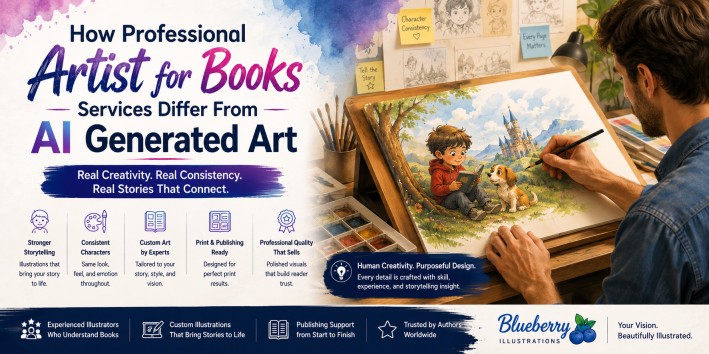
Many first-time authors initially view illustrations as individual images created to accompany text. Professional publishing workflows frequently approach illustrations differently.
Within a finished book, artwork often serves multiple purposes simultaneously. An illustration is not only expected to look appealing. It is expected to support reading flow, maintain visual consistency, and function correctly during production and printing.
This difference becomes more visible when moving from a single image to a complete book project. Individual artwork may appear visually impressive while still creating difficulties during formatting and production.
For example, an important facial expression may sit too close to the page edge. Background elements may compete with text readability. Characters may drift into the center gutter of a double-page spread. Resolution limitations may become noticeable during high-quality printing. Small inconsistencies in clothing, proportions, or visual style may also become more apparent when readers move across multiple pages.
Professional artists and experienced publishing teams frequently anticipate these issues before artwork production begins. Rather than treating each image as an isolated design, they often build illustrations around the structural requirements of the complete book.
Within professional illustration workflows, artwork development frequently extends beyond the literal representation of written text. Illustrators often interpret narrative context, emotional tone, pacing, and character intention before visual production begins. As a result, the illustration process may involve translating written information into visual storytelling decisions rather than creating direct visual copies of individual sentences.
In illustrated books, the manuscript frequently contains both explicit and implied information. Explicit information consists of events that are directly stated in the text, while implied information may include emotional conditions, character relationships, atmosphere, tension, or narrative emphasis. Professional artists for books often evaluate both forms of information when developing scenes.
For example, a manuscript may state that a child is sitting alone after making a mistake. The written sentence describes an event; however, visual interpretation may also consider emotional and environmental context.
These decisions are commonly associated with visual narrative design, where illustrations function as interpretive storytelling elements rather than purely descriptive images.
Professional book illustrations frequently contain forms of visual subtext that are not directly stated within the manuscript itself. Visual cues may guide readers toward important emotional information, indicate shifts in narrative tone, reinforce character development, or direct attention toward details relevant to later events in the story.
This process is particularly significant within picture books, early-reader publications, and family read-aloud formats, where visual information often contributes substantially to narrative understanding and reader engagement.
Within professional artist for books services and children's book illustration services, manuscript interpretation refers to the process of translating written content into visual narrative elements. The process frequently extends beyond direct representation of text and may include interpretation of emotional context, scene atmosphere, narrative pacing, and character relationships.
In many professionally illustrated books, written language and visual language perform complementary functions. Text commonly communicates explicit information such as actions, dialogue, and events, while book illustrations may communicate implied information including emotional conditions, environmental context, symbolic details, and narrative emphasis.
Professional author illustrators, story book illustrators, and illustration studios frequently evaluate multiple factors before scene development begins.
For example, a manuscript may state that a child sits alone after making a mistake. The written text establishes the event itself, whereas visual interpretation may incorporate additional contextual elements. Scene scale may be adjusted to influence perceptions of isolation, composition may affect emotional emphasis, and environmental details may provide information regarding previous actions or character conditions.
Within professional book illustration services, manuscript interpretation is frequently considered part of the broader visual storytelling process rather than the production of standalone images. This approach contributes to narrative continuity, emotional development, and reader comprehension across the complete publication.
Within illustrated publishing workflows, image composition and text placement are frequently treated as interconnected design elements rather than independent processes. In many book formats, particularly children's books, early-reader publications, and illustrated narratives, written content is commonly integrated directly into the artwork itself. As a result, illustration development often includes planning for future typography requirements before final artwork production begins.
Composition within book illustrations commonly extends beyond aesthetic arrangement alone. Visual structure may also influence readability, reader attention, narrative pacing, and the relationship between text and imagery on the page. Professional artist for books services and book illustration companies frequently evaluate these variables during scene planning.
Common composition considerations may include:
In book design, negative space is frequently used as a functional design component rather than an unused portion of the page. Open sky areas, simplified wall surfaces, plain environmental regions, and reduced visual detail may provide locations for text while maintaining readability and preserving important visual information.
Page architecture may also influence illustration decisions. Important characters, facial expressions, and narrative details are commonly positioned away from trim areas and center gutters to reduce the risk of content loss during printing and binding processes.
Highly detailed artwork containing extensive textures, patterns, lighting effects, or dense object placement may introduce additional layout challenges when typography is added later. Text may overlap important visual information, require additional design elements such as text boxes, or reduce readability within the final publication.
Consequently, professional book illustrations frequently treat composition as both a visual and structural system intended to support storytelling, typography, and print production requirements simultaneously.
Within professional book publishing services, illustration production and print preparation are commonly treated as interconnected processes. During book manufacturing and self-publishing workflows, artwork frequently needs to satisfy specific technical requirements before files can be approved for printing and distribution.
Publishing platforms used to publish books on Amazon and other print-on-demand systems, including Amazon KDP and IngramSpark, typically require artwork and interior layouts to conform to predefined production specifications. These requirements may vary according to trim size, page count, binding method, paper selection, and cover configuration.
Professional artist for books services, book formatting services, and illustration studios frequently evaluate multiple technical variables during production preparation.
Common production requirements may include:
These production specifications frequently influence illustration decisions during artwork development rather than after artwork completion. Visual elements placed too close to trim areas may become partially removed during printing. Text located near safe margins may be cut off or become difficult to read. Important character expressions placed near the center gutter may become obscured after binding.
Technical inconsistencies may also create issues during upload and print preparation workflows. Common problems can include upload rejections, reduced image quality, distorted cover dimensions, inaccurate spine alignment, text placement errors, or visual information becoming partially hidden within the final printed book.
Professional book illustration services and book publishing companies frequently treat artwork, formatting, and publishing-ready file production as components of a unified workflow rather than as separate stages. This approach allows illustration decisions to align with the requirements of the finished printed publication.
Within publishing workflows, cover illustration is frequently regarded as both a visual and commercial design component of a book. Unlike interior illustrations, which primarily support narrative content, book covers commonly function as discovery and identification systems intended to attract reader attention and communicate information about the publication.
Professional artist for books services, book publishing services, and illustration studios frequently evaluate cover development according to audience expectations, marketplace behavior, and platform requirements. In digital publishing environments, covers may also function at multiple viewing scales, including full-size print presentation and reduced thumbnail displays on online marketplaces.
Professional cover design workflows commonly evaluate several factors, including:
Digital publishing platforms and self-publishing systems frequently introduce additional technical requirements. Complete cover preparation commonly includes front cover artwork, back cover design, spine dimensions, bleed extensions, trim specifications, safe margins, and print-ready file preparation. Spine dimensions may vary according to page count, paper type, and binding configuration.
Cover performance may also be influenced by marketplace behavior. On platforms used to publish books on Amazon and other online bookstores, readers frequently encounter books initially through reduced thumbnail displays. As a result, typography, composition, and focal elements commonly require sufficient clarity to remain recognizable at smaller viewing sizes.
Consequently, professional book publishing services and Amazon self publishing company workflows frequently treat cover development as a combined process involving illustration, typography, production specifications, and marketplace presentation rather than the selection of a single standalone image.
Within professional book illustration workflows, style consistency commonly refers to the maintenance of stable visual characteristics across illustrations within a publication. In illustrated books, visual continuity may influence reader perception, narrative cohesion, and the overall presentation quality of the final work.
Illustrated publications frequently contain recurring characters, environments, objects, and sequential scenes distributed across multiple pages. As a result, individual illustrations are often expected to function as components of a unified visual system rather than as independent artworks. Variations in artistic treatment between pages may alter the perceived relationship between scenes and can affect visual continuity throughout the publication.
Professional artist for books services, story book illustrators, and illustration studios frequently establish predefined visual standards before full artwork production begins. These standards may function as reference systems intended to maintain consistency across the complete publication.
Common visual variables evaluated during production may include:
Within illustrated publishing, stylistic variation may become more noticeable across sequential pages than within isolated artwork. Changes in rendering methods, proportions, environmental detail, or visual treatment can create differences in perceived continuity when readers move through the narrative.
Style consistency may also influence broader publishing considerations, including reader recognition and series development. In children's book illustration services and recurring book properties, stable visual presentation can contribute to recognizable identity across multiple titles and related publications.
Professional illustration firms and book illustration companies frequently use approved character sheets, style guides, color references, and production standards to maintain visual continuity throughout illustration and publishing workflows.
Within children's book illustration services and professional book illustration workflows, visual simplification is commonly regarded as a component of information hierarchy and reader guidance. Illustration development frequently involves decisions regarding which visual elements should receive emphasis and which details may be reduced or omitted.
Illustrated pages may contain multiple forms of information simultaneously, including characters, environments, actions, emotional cues, and written content. Excessive visual complexity can increase competition between these elements and may affect readability and narrative clarity.
Professional artist for books services, story book illustrators, and illustration firms frequently evaluate several factors when determining visual complexity levels.
Common considerations may include:
In printed publications, highly detailed illustrations may also introduce technical considerations. Small textures, complex patterns, and dense environmental details can become less distinguishable when reproduced at reduced sizes or viewed from a distance. Variations may become more noticeable in picture books, early-reader formats, and publications intended for repeated viewing.
Professional book illustrations frequently apply selective detail rather than uniform detail distribution. Primary subjects, facial expressions, and narrative actions may receive greater visual emphasis, while secondary elements may be simplified to preserve clarity and direct reader attention.
Within illustrated publishing, visual simplification is therefore commonly regarded not as a reduction of artistic quality, but as a method for improving narrative communication, readability, and visual continuity throughout the publication.
Within book publishing workflows, copyright and usage rights commonly represent important considerations during illustration development and publication preparation. Rights management may influence how artwork can be reproduced, distributed, modified, marketed, and reused across future publishing activities.
Professional artist for books services, illustration firms, and book publishing services frequently establish project agreements intended to define ownership structures and permitted uses of creative work. Such agreements commonly describe project deliverables, licensing conditions, revision policies, reproduction permissions, and publication scope.
Common rights and ownership considerations may include:
Digital illustration workflows and AI-generated imagery may introduce additional considerations because usage conditions can vary according to platform policies, licensing structures, levels of human involvement, and marketplace requirements. Rights and permitted uses may differ between tools and publishing environments.
For self-publishing authors, rights management may extend beyond initial book production. Illustrations may later be used for marketing materials, websites, author branding, school presentations, bookstore promotion, companion products, or future titles within a series. As a result, publication workflows frequently benefit from clear documentation regarding ownership and permitted usage.
Consequently, copyright and licensing considerations are often treated as part of broader publishing preparation processes rather than as isolated legal or administrative issues.
Within professional illustration workflows, revisions are commonly regarded as a structured part of the production process rather than isolated corrections made after artwork completion. Changes may occur as manuscripts evolve, page layouts are adjusted, or technical requirements become apparent during formatting and print preparation.
Illustration revisions frequently involve interconnected visual elements because changes to one component can affect multiple areas of the publication. Professional artist for books services commonly establish approved references before final production begins so that adjustments can be made without disrupting visual continuity.
Common revision areas may include:
In illustrated books, modifications are often expected to preserve character identity, scene consistency, and narrative continuity across multiple pages. A change in clothing design, proportions, or composition on one page may require corresponding adjustments throughout the publication.
AI-generated imagery may introduce additional workflow considerations because modifications to a single element can sometimes affect other visual characteristics within the image. As a result, revision management frequently depends on maintaining controlled references and production standards throughout the illustration process.
Artificial intelligence has become an increasingly useful tool within modern publishing workflows. It can assist with concept exploration, visual brainstorming, rough illustration references, and cost-effective artwork generation for authors working within limited budgets or faster production timelines. AI can also help accelerate early stages of creating a picture book by reducing the time required for initial visual development.
However, generating images alone does not automatically create a publication-ready book. Professional publishing involves multiple technical and creative stages that directly influence readability, print quality, and marketplace acceptance.
AI by itself does not automatically solve important publishing requirements such as:
This is why AI generally performs best when guided by professionals who understand children's book illustration, book publishing services, self publishing workflows, and production requirements. The challenge for many authors is often not creating a single image — it is creating an entire book system that works from beginning to end.
Authors searching for topics such as publish book on Amazon, publish book Kindle, how to publish children's story books, how to publish a children's novel, or creating a picture book frequently discover that successful publishing depends on far more than artwork alone. A book must be readable, visually consistent, technically correct, print-ready, and professionally organized before publication.
When AI is combined with experienced publishing guidance, however, it can create an effective balance between affordability and professional quality. Expert oversight can help maintain character consistency, improve storytelling structure, ensure print compliance, and prepare complete publishing-ready files.
For authors seeking a more affordable approach, Blueberry Illustrations offers AI-assisted publishing packages starting at only $249, including illustrations, cover design, inside book formatting, and publishing-ready files prepared with professional oversight to help simplify the self-publishing process.
Professional artist for books services often become the stronger option when quality, visual consistency, and long-term publishing value are important. While AI tools may assist with early concept development or lower-budget projects, many publishing situations benefit from a more structured illustration process and professional creative oversight.
This is especially important when:
For serious publishing projects, professional illustration is often more than an artistic expense. It can become part of a book's identity, reader experience, visual readability, and long-term market value. Authors creating a picture book, planning to publish book on Amazon, or learning how to publish children's story books frequently discover that strong illustration quality contributes significantly to how readers perceive the finished product.
Not every author begins with a large budget. Some authors want to test an idea, publish a personal story, create a simple children’s book, or enter the self-publishing world at a lower cost.
In these cases, AI assisted publishing can be a practical alternative, especially when the work is reviewed and prepared by experienced publishing professionals.
The safest AI assisted workflow still needs:
AI can reduce production cost, but expert oversight helps reduce common problems. This creates a middle path for budget-conscious authors who cannot afford fully custom illustration but still want better results than a do-it-yourself AI workflow.
Blueberry Illustrations provides children’s book illustration services, book design, cover design, formatting, and publishing preparation for authors who want professional support. The company works with authors who need custom artwork as well as authors who need more affordable AI assisted options.
For authors who want professional book illustration, Blueberry Illustrations can help with character design, scene planning, book illustrations, cover design, and publishing-ready layout. This is useful for writers who want a polished book that feels consistent from cover to final page.
For authors with very limited budgets, Blueberry Illustrations also offers affordable AI assisted publishing packages starting at only $249. These packages include illustrations, cover design, inside book design, and publishing-ready files. This option helps first-time authors begin with a lower investment while still receiving expert guidance for layout, consistency, and publishing preparation.

Professional artist for books services differ from AI generated art because they provide more than image creation. They bring visual planning, manuscript interpretation, character consistency, page composition, technical print knowledge, revision control, and publishing experience.
AI generated art can be helpful, especially for concept work and budget-friendly publishing, but a published book requires a complete production system. The artwork must support the story, fit the page, protect the text, meet print requirements, and create a consistent reader experience.
For authors who want the strongest long-term result, professional artists remain the better choice. For authors with very limited budgets, AI assisted publishing with expert oversight can still offer a practical starting point.
Blueberry Illustrations helps authors choose the path that fits their goals, whether they need professional artist for books services or affordable AI assisted publishing support starting at only $249.



To explore more self publishing tips and resources that can guide you in writing, designing, and publishing your book, click on this link.
Click here to visit our Home Page.
Click here to view the portfolio of children’s book illustrations by Blueberry Illustrations: https://blueberryillustrations.com/childrens-book-illustrationsClick here to explore affordable publishing packages offered by Blueberry Illustrations: https://blueberryillustrations.com/affordable-publishing-packagesClick here to read author testimonials and reviews of Blueberry Illustrations: https://blueberryillustrations.com/book-reviewClick here to view the Amazon book store featuring books published by Blueberry Illustrations: https://blueberryillustrations.com/book-storeClick here to watch videos showcasing Blueberry Illustrations’ publishing and illustration work: https://blueberryillustrations.com/videos