Our Happy
Authors


A Comprehensive Guide for Authors
For many authors, publishing a book is more than simply completing a project.
It may begin as a bedtime story, a personal idea developed over many years, a family memory, or a story created to inspire young readers.
When authors reach the illustration stage, many discover that choosing the right book illustration companies can influence far more than the artwork itself.
Illustrations often shape how readers connect with characters, understand emotions, and experience the story. They can also affect page layouts, visual consistency, publishing quality, and the overall presentation of the final book.
Many first-time authors focus mainly on price or individual sample images and unintentionally overlook other factors such as communication processes, publishing experience, revision structure, or character consistency across pages.
In this article, we will explore common hidden mistakes authors make when hiring book illustration companies and discuss factors that can help create a smoother publishing experience.
Many publishing problems begin before illustrations are even created. Authors sometimes focus mainly on artwork samples while overlooking other factors that influence the final book experience.
Many of these details are not immediately visible in a portfolio, but they can significantly influence the quality and publishing readiness of the final book.
Many first-time authors evaluate illustrations mainly by asking a simple question: “Does the artwork look good?” Professional publishing teams often look at additional factors.
Illustrations in children's books are expected to do more than create attractive images. They frequently influence pacing, readability, emotional understanding, and how readers move through the story.
For example, a strong illustration may need to consider:
In picture books and early-reader books, illustrations often become part of the storytelling structure itself. Young readers may understand emotions, actions, and story progression through visual information before fully processing written text.
This is one reason many publishing workflows treat illustration planning as part of story development rather than as a separate design stage added after the manuscript is complete.
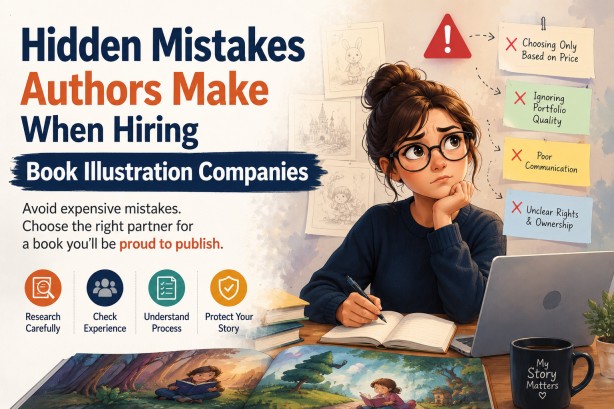
Many first-time authors compare book illustration companies mainly by looking at sample artwork and package pricing. While pricing is important, authors sometimes discover later that two projects with similar prices may include very different levels of publishing support.
Illustrations for a complete book often involve much more than creating individual images.
Areas that authors frequently overlook include:
Many authors only encounter these issues after formatting begins or when files are uploaded for printing.
For this reason, experienced publishing teams often evaluate the complete workflow rather than focusing only on the starting price of the illustrations.
Strong artwork alone does not automatically create a publishing-ready book. Creating illustrations and preparing a book for print or digital publishing often involve different skill sets.
Many talented artists specialize in creating individual pieces of artwork, but complete books frequently introduce additional technical and design considerations.
Areas that authors sometimes overlook include:
These details may appear small during the illustration stage, but they can affect the reading experience and final printed result.
For example:
Many authors only notice these issues after receiving physical proofs or reviewing printed copies. For this reason, illustration decisions and publishing requirements are often planned together rather than treated as separate stages.
Many first-time authors evaluate illustrations mainly by asking whether the artwork looks visually attractive. However, in children's publishing, illustrations often serve a larger purpose than simply showing what a scene looks like.
Illustrations frequently help readers understand emotions, relationships, and story progression, especially for younger children who may process visual information before fully processing written text.
Elements that often influence emotional storytelling include:
For example, a happy scene and a tense scene may contain the same characters and setting, but changes in expression, color tone, composition, and movement can create very different emotional responses.
In children's books, illustrations often help guide readers toward how a moment should feel, not simply what is happening within the story.
Many first-time authors focus heavily on illustrations and may assume that strong artwork alone will create a strong reading experience. However, illustrations are only one part of how a book is experienced from beginning to end.
Children's books often depend on rhythm and pacing. Small decisions in text placement, page structure, and scene progression can influence how naturally the story moves from one moment to the next.
Areas that frequently affect book flow include:
For example, too much text on a page can make early readers feel overwhelmed, while too many visual elements competing for attention may make important story moments less clear.
Many publishing teams review books as complete reading experiences rather than evaluating illustrations, text, and layouts separately. Small adjustments in structure and pacing often influence how smooth and engaging the final book feels.
AI has changed how many children's books can be created by making illustration and publishing workflows more accessible and affordable for authors.
Today, many authors choose AI-assisted publishing because it can reduce production costs and shorten development time, especially for first-time authors and independent creators.
However, many authors assume that generating individual images automatically creates a complete illustrated book.
In practice, a finished book often still requires additional planning and creative decisions.
Areas that commonly require expert guidance include:
AI-assisted workflows and fully customized illustration workflows often serve different publishing goals. Some authors choose custom illustration approaches for highly specific artistic direction, while others choose AI-assisted workflows as a more affordable and efficient option.
Blueberry Illustrations also offers AI-assisted publishing packages starting at just $249, designed to help authors combine affordability with structured creative guidance and publishing support.
In many publishing workflows, AI functions as a creative tool rather than a complete replacement for publishing knowledge. Creative direction, editing, illustration review, and publishing experience often help ensure that individual images work together as a complete reading experience.

Many first-time authors spend significant time comparing illustration styles, pricing, and sample artwork. While these factors are important, they do not always provide a complete picture of how a company manages an entire publishing project.
Creating individual illustrations and managing a complete book workflow involve very different responsibilities. Throughout a project, authors may go through manuscript revisions, page planning, formatting decisions, publishing preparation, and multiple rounds of creative feedback.
Before hiring a book illustration company, the following areas should be reviewed carefully:
Many publishing challenges become visible later in the process rather than during the initial stages of a project. Reviewing completed books, client experiences, and publishing knowledge can provide a clearer understanding of how a company manages complete book development beyond individual artwork samples.



To explore more self publishing tips and resources that can guide you in writing, designing, and publishing your book, click on this link.
Click here to visit our Home Page.
Click here to view the portfolio of children’s book illustrations by Blueberry Illustrations: https://blueberryillustrations.com/childrens-book-illustrationsClick here to explore affordable publishing packages offered by Blueberry Illustrations: https://blueberryillustrations.com/affordable-publishing-packagesClick here to read author testimonials and reviews of Blueberry Illustrations: https://blueberryillustrations.com/book-reviewClick here to view the Amazon book store featuring books published by Blueberry Illustrations: https://blueberryillustrations.com/book-storeClick here to watch videos showcasing Blueberry Illustrations’ publishing and illustration work: https://blueberryillustrations.com/videos