Our Happy
Authors


A Comprehensive Guide for Authors
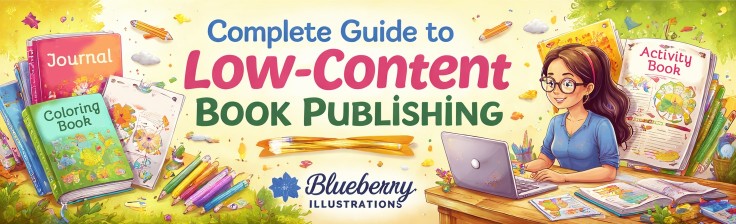
Low-content books have become one of the fastest-growing segments in modern publishing. Unlike traditional books that rely heavily on written content, low-content book publishing focuses on structure, usability, and visual design. Journals, planners, coloring books, and activity books are widely used for productivity, creativity, education, and relaxation.
With the rise of platforms like Amazon KDP publishing, many creators are exploring how to turn simple ideas into scalable low-content book products. However, success in this space is not just about uploading a file—it requires professional design, proper formatting, and a clear understanding of what sells in the market.
Many creators struggle to design, format, and publish low-content books that actually perform well in competitive marketplaces.
This guide explains how low-content book publishing works and how to create books that are both professional and market-ready.
Low-content books are a category of publications that contain minimal written content and rely mainly on structured layouts, guided pages, and user interaction. Instead of focusing on long reading material, these books are designed for the reader to fill, use, or engage with directly.
They have become increasingly popular in self-publishing, especially on platforms like Amazon KDP, because they are simple to produce, cost-effective, and scalable across multiple niches and audiences.
Unlike traditional books, the value of low-content books comes from their design structure and usability rather than written storytelling. Each page is intentionally formatted to guide user behavior, whether it is writing, planning, tracking, or creative activity.
Common types of low-content books include:
Although they appear simple, successful low-content books require thoughtful planning of layout design, spacing, margins, and user flow. A well-designed structure directly impacts usability, engagement, and overall market performance.
Low-content books have gained strong popularity in modern self-publishing because they combine simplicity, scalability, and consistent market demand. Unlike traditional publishing, they do not require long manuscripts, which makes them accessible to new creators as well as experienced publishers.
Another major reason for their growth is their flexibility. A single concept can be transformed into multiple formats such as journals, planners, or activity books, allowing publishers to quickly expand their product range and target different audiences.
They are also widely used on platforms like Amazon KDP because they can be published in bulk and adapted for niche markets with relatively low production effort. This makes them attractive for creators looking to build long-term digital publishing assets.
Key reasons for their popularity include:
However, the simplicity of low-content books is often misunderstood. Without proper design, layout structure, and market positioning, many books fail to gain traction. This is why professional formatting, design strategy, and publishing expertise play an important role in achieving consistent sales.
A professional book publishing service plays a critical role in transforming a simple idea into a commercially viable product. In low-content book publishing, success depends not only on creativity but also on structured execution, market understanding, and platform optimization.
These services help bridge the gap between concept creation and a fully publishable product that meets industry and platform standards such as Amazon KDP requirements.
Their responsibilities typically include:
Working with experienced illustration firms or a professional illustration agency ensures that the final product is not only visually appealing but also aligned with market expectations and buyer behavior.
Design and layout form the foundation of low-content book publishing because users interact with every page directly. Unlike traditional books, where reading is the primary experience, here the design itself becomes the product experience.
A poorly structured layout can reduce usability, while a well-planned design significantly improves engagement, perceived value, and overall sales performance on platforms like Amazon KDP.
Key design considerations include:
Books created without professional design input often appear generic and inconsistent, which reduces trust, lowers conversion rates, and impacts long-term sales potential in competitive marketplaces.
In coloring books and activity books, illustrations are not just decorative elements—they form the core of the entire user experience. Unlike text-heavy books, these formats depend entirely on visual storytelling, structure, and engagement-driven artwork.
Well-designed illustrations directly influence how users interact with the book, how long they engage with it, and how valuable the book feels in both educational and creative contexts.

Professional book illustrations help in several key ways:
Illustration quality also plays a major role in determining the success of low-content books in competitive marketplaces. Inconsistent or low-quality artwork can reduce user interest, while professionally developed visuals improve credibility and market positioning.
This is why many authors and publishers collaborate with an illustration company, professional illustration studios, or experienced story book illustrators. Working with specialized Children’s Book Illustration Services ensures that the artwork is aligned with publishing standards, target audience expectations, and commercial requirements.

Publishing a low-content book requires technical accuracy because even small formatting errors can affect print quality, approval status, and overall user experience. Platforms like Amazon KDP follow strict guidelines to ensure books are printable, consistent, and professionally aligned.
A professional book publishing company ensures that every file is prepared according to industry and platform-specific standards, reducing the risk of rejection and ensuring high-quality output across print and digital formats.
Key formatting requirements include:
Incorrect formatting can lead to serious issues such as rejected uploads, misaligned pages, cut-off designs, or poor print clarity. These errors not only affect the visual quality of the book but also reduce customer trust and negatively impact sales performance.
Success in low-content publishing depends heavily on selecting the right niche, because it directly influences visibility, competition level, and long-term sales performance on platforms like Amazon KDP.
A well-chosen niche ensures that your book targets a specific audience with existing demand, while also maintaining a balance between competition and discoverability in search results.
When selecting a profitable niche, it is important to evaluate:
A strategic niche selection approach not only improves your chances of ranking higher when you publish a book on Amazon, but also increases the long-term profitability and scalability of your low-content book portfolio.
The book cover is one of the most important factors in low-content publishing because it directly influences click-through rate, visibility, and overall sales performance on platforms like Amazon KDP. In most cases, customers decide within seconds whether to explore a book based on its cover.
Unlike traditional books, low-content book covers must perform well in thumbnail view, where clarity and visual impact are more important than detailed artwork.
Effective covers are designed with both visual appeal and marketing performance in mind. Key elements include:

Professional book illustration companies and experienced designers understand how to create covers that not only look visually appealing but also improve conversion rates and search performance on competitive publishing platforms.
One of the most common questions in low-content publishing is: how much does it actually cost to publish a book? The answer depends on multiple stages of production, not just the final upload process.
Unlike traditional publishing, costs in low-content books are flexible and directly influenced by design quality, niche strategy, and the level of professional support involved in the project.
Key cost factors include:
While low-content books are generally more affordable to produce compared to content-heavy books, pricing should not be evaluated only on cost. Higher-quality design and illustration significantly improve visibility, perceived value, and long-term sales performance on platforms like Amazon.
In most cases, professionally designed books generate better returns because they are optimized for both user experience and marketplace competitiveness, making them more sustainable as digital publishing assets.
Many low-content book projects fail not because of weak ideas, but because of avoidable mistakes in design, formatting, and publishing strategy. On platforms like Amazon KDP, even small errors can significantly reduce visibility, conversion rates, and long-term sales performance.
Understanding these mistakes helps creators build more professional and market-ready books from the start.
Common pitfalls include:
These mistakes often result in reduced visibility in search rankings, lower customer trust, and weak sales performance, especially in competitive categories like journals, planners, and coloring books.
Artificial intelligence is increasingly being used in low-content book publishing for generating ideas, layouts, and basic design structures. It offers speed and efficiency, especially for creators looking to produce content quickly for platforms like Amazon KDP.
However, while AI can accelerate the production process, it does not fully replace the strategic, creative, and commercial decision-making required to build successful publishing products.
Where AI can assist in publishing:
Where AI falls short in professional publishing:
Although low-content books may appear simple, success depends heavily on originality, design consistency, and market positioning. AI-generated outputs often struggle to achieve the level of refinement required to stand out in competitive publishing categories.
For a deeper understanding of how AI impacts illustration quality and publishing outcomes, you can read more details here: Click here to learn more about AI in children’s book illustrations.
For serious creators and publishers, combining technology with human expertise is the most effective approach. Working with professional illustrators, experienced publishing teams, or an illustrator agency ensures that the final product maintains originality, visual quality, and commercial viability.
While AI tools can support early-stage creation, they cannot replace the strategic and creative depth provided by professional book publishing services.
Professional teams bring not only design execution but also publishing intelligence—understanding what sells, how users engage with books, and how to optimize for platforms like Amazon KDP.
Key advantages of working with professionals include:
In competitive categories like low-content books, professional refinement often determines whether a book becomes discoverable and profitable or gets lost in saturated marketplaces.








Low-content books provide a strong entry point into the publishing industry because they require fewer barriers to start compared to traditional book publishing. However, long-term success in this space depends on much more than just creating simple content.
Factors such as professional design, structured layouts, niche selection, and strategic publishing decisions play a crucial role in determining how well a book performs on platforms like Amazon KDP.
Whether you are exploring how to publish children’s story books, developing a picture book, or launching a series of journals and planners, having the right creative and technical support can significantly improve the quality and market readiness of your work.
In today’s competitive publishing environment, creators who focus on design quality, visual storytelling, and professional execution are far more likely to build successful and sustainable publishing portfolios.
1. What are low-content books?
Low-content books are books with minimal written content, such as journals, planners, and coloring books, focusing more on layout and usability.
2. How do I publish a low-content book on Amazon?
You can publish through Amazon publishing platforms like KDP by preparing a properly formatted interior file and cover, then uploading them to your account.
3. Do low-content books require illustrations?
Not all, but coloring books and activity books rely heavily on professional book illustrations for success.
4. Can I use AI to create low-content books?
AI can help with ideas and basic layouts, but it often lacks the creativity and quality needed for competitive publishing.
5. How much does it cost to publish a low-content book?
Costs vary depending on design, illustrations, and formatting. Investing in professional book editing services and design improves overall quality and sales potential.
6. Should I hire professionals or do it myself?
While DIY is possible, working with experienced illustration firms, story book illustrators, and book publishing services ensures a higher-quality and more successful final product.
To explore more self publishing tips and resources that can guide you in writing, designing, and publishing your book, click on this link.
Click here to visit our Home Page.
Click here to view the portfolio of children’s book illustrations by Blueberry Illustrations: https://blueberryillustrations.com/childrens-book-illustrationsClick here to explore affordable publishing packages offered by Blueberry Illustrations: https://blueberryillustrations.com/affordable-publishing-packagesClick here to read author testimonials and reviews of Blueberry Illustrations: https://blueberryillustrations.com/book-reviewClick here to view the Amazon book store featuring books published by Blueberry Illustrations: https://blueberryillustrations.com/book-storeClick here to watch videos showcasing Blueberry Illustrations’ publishing and illustration work: https://blueberryillustrations.com/videos