Many authors focus on choosing an amazon self publishing company or exploring book publishing services—but the real success of a children’s book begins much earlier. Before you think about how to publish book on Amazon or work with book editing services, the foundation lies in storytelling.
Strong characters and meaningful storylines are what truly capture a child’s attention. These are the elements that make a story memorable, relatable, and worth revisiting again and again.
This guide focuses purely on the craft of storytelling to help you build a children’s book that not only engages young readers but also creates a lasting emotional connection.
Why Strong Characters and Storylines Matter in Children’s Literature
Children don’t connect with books simply because they look beautiful—they connect because they see themselves inside the story. While illustrations may capture attention, it is the character’s emotions, choices, and journey that make a child want to return to a book again and again.
In children’s literature, characters act as a bridge between imagination and real-life understanding. When a child relates to a character—whether it’s fear of the dark, making a new friend, or learning something new—the story becomes meaningful and memorable.
A strong storyline gives direction and purpose to the character. It helps structure the story in a way that is easy for children to follow while still being emotionally engaging.
A well-developed children’s story typically answers three key questions:
- What does the character want?
- What challenge or problem do they face?
- How do they grow or change by the end?
For example, a shy rabbit is not enough to hold a child’s attention. But a shy rabbit who must overcome fear to help a friend during a storm creates emotion, tension, and a meaningful journey.
This is why strong storytelling is essential. No matter how high-quality the illustrations or how professional the publishing process is, a weak story cannot create a lasting impact. The story builds the connection, while visuals only enhance the experience.
Understanding Your Target Age Group and Reading Behavior
Before creating your story, it is important to understand who you are writing for. Different age groups respond to stories in very different ways, and your content should match their level of understanding and emotional development.
- Toddlers (2–5 years): Stories should have simple plots, repetitive language, and clear, bright emotions that are easy to recognize.
- Early Readers (5–8 years): These readers enjoy clear problems, playful dialogue, and light conflict that is easy to resolve.
- Middle Grade (8–12 years): Stories can include deeper emotions, stronger character development, and more meaningful story arcs.
Understanding your audience helps you shape not just the story, but also the pacing, language, and overall structure. A story that works well for one age group may not connect with another.
This step is essential whether you are planning to publish independently or working with professional book publishing service providers.
Creating Relatable Characters Children Instantly Connect With
Great children’s books often feature characters that are simple, expressive, and easy for young readers to understand and relate to.
- Curious children who explore and learn
- Talking animals with human-like thoughts and feelings
- Magical beings who experience real emotions
- Characters who face small, relatable everyday challenges
- Heroes who are imperfect but try their best
- Friends or siblings that reflect real-life relationships
- Characters with a clear goal or desire
- Personalities that show kindness, bravery, or growth
No matter who you are working with—whether individual illustrators or a professional illustration agency—the character must feel real and emotionally engaging.
To build a strong character, ask yourself:
- What does my character want?
- What are they afraid of?
- What makes them different or unique?
- What problem are they trying to solve?
- How do they change by the end of the story?
When a child recognizes these emotions and traits, they form an instant connection with the character, making the story more memorable and impactful.
Building Clear Character Motivation and Emotional Stakes
A strong story begins when a character wants something deeply. This desire becomes the driving force that moves the story forward and keeps young readers emotionally invested.
When children understand what a character wants, they naturally begin to care about what happens next. The clearer the motivation, the easier it is for a child to follow and connect with the story.
Examples of simple but effective character motivations:
- A bunny who wants to make a friend
- A child who wants to overcome fear
- A fairy who wants to prove herself
- A lost puppy trying to find its way home
- A student who wants to win a school competition
- A character trying to fix a mistake they made
However, motivation alone is not enough. To make a story engaging, you also need emotional stakes. This means the goal must feel important, and there should be consequences if the character fails.
A simple way to strengthen your story is to combine three key elements:
- A clear desire (what the character wants)
- A meaningful obstacle (what is stopping them)
- An emotional response (how the character feels during the journey)
For example, instead of writing “a bunny wants a friend,” you can create a stronger story: a shy bunny who fears rejection must ask another animal for help during a storm. This adds tension, emotion, and purpose to the storyline.
To build stronger emotional stakes, ask yourself:
- What happens if the character fails?
- Why is this goal important to them?
- Who or what is standing in their way?
- What emotions are they experiencing during the journey?
- How will they change by the end of the story?
Many beginner stories fail because the character’s goal is too easy to achieve or lacks emotional weight. When there is no real challenge or consequence, children lose interest quickly.
When both motivation and emotional stakes are clear and meaningful, the story becomes more engaging, memorable, and impactful for young readers. This foundation is essential, whether you plan to publish independently or work with professional illustrators and publishing teams.
How to Create Emotional Connection Between the Child Reader and Your Story
Children connect with stories when they recognize their own feelings inside the character. The goal is not just to tell a story, but to make the child feel, “That’s exactly how I feel too.”
To create this connection, you need to move beyond general ideas and focus on specific emotional moments.
Instead of writing broad statements like “the child was scared,” show the emotion through a real situation:
- Fear of the dark when the lights go off at night
- Nervousness on the first day of school
- Jealousy when a sibling gets more attention
- Sadness when a friend doesn’t want to play
- Excitement before a birthday or special event
These specific moments help children immediately recognize and connect with the story.
Another key technique is to show emotions through actions, not explanations. For example:
- Instead of saying “he was nervous,” show him hiding behind a parent
- Instead of “she was brave,” show her trying again after failing
- Instead of “they were happy,” show them laughing, jumping, or hugging
You can also strengthen emotional connection by adding small internal struggles:
- Wanting to try something but feeling scared
- Making a mistake and worrying about the consequences
- Trying to fit in but feeling different
A simple way to check your story is this: if you remove the illustrations, does the emotion still come through clearly in the actions and situations? If yes, the connection is strong.
When children feel understood, they stay engaged and remember the story long after reading it. This emotional connection is what truly makes a children’s book successful, regardless of how it is published or illustrated.
Designing Simple Yet Powerful Story Conflicts for Young Readers
Conflict is what gives a story direction and meaning. It begins when a character wants something but faces difficulty in achieving it. Without conflict, the story feels flat because nothing challenges the character or forces them to grow.
In children’s stories, conflict works best when it is simple in structure but strong in emotion. This usually comes from combining two types of challenges:
- External conflict, where something in the world creates a problem, such as losing an object, facing a task, or dealing with a situation
- Internal conflict, where the struggle comes from within the character, such as fear, doubt, shyness, or hesitation
The most engaging stories connect both. For example, a child may need to perform on stage, but their fear of making a mistake becomes the real obstacle they must overcome.
A practical way to design conflict is to build it in three layers:
- A clear goal that the character strongly wants to achieve
- An obstacle that prevents them from reaching it easily
- A series of struggles that test their effort, patience, or emotions
Instead of resolving the problem quickly, the conflict should develop gradually. Each attempt should either fail or make the situation more challenging, pushing the character to think, act, or feel differently.
Equally important are the stakes, which explain why the conflict matters. In children’s stories, stakes are often emotional rather than physical:
- The fear of embarrassment, rejection, or failure
- The desire to achieve something meaningful or important
- The risk of disappointing someone they care about
For example, a simple idea like “a child loses a toy” becomes more engaging when expanded into a journey: the child searches in the wrong places, begins to feel worried or upset, and only succeeds after persistence or a change in thinking.
A common mistake is making the conflict too easy or skipping the struggle entirely. When the character succeeds without effort or change, the story loses its impact. Each part of the story should either increase the difficulty or reveal something new about the character.
When conflict is built with clear goals, meaningful obstacles, and emotional stakes, even a simple story becomes engaging, relatable, and memorable for young readers.
Designing Simple Yet Powerful Story Conflicts for Young Readers
Conflict is what gives a story direction and meaning. It begins when a character wants something but faces difficulty in achieving it. Without conflict, the story feels flat because nothing challenges the character or forces them to grow.
In children’s stories, conflict works best when it is simple in structure but strong in emotion. This usually comes from combining two types of challenges:
- External conflict, where something in the world creates a problem, such as losing an object, facing a task, or dealing with a situation
- Internal conflict, where the struggle comes from within the character, such as fear, doubt, shyness, or hesitation
The most engaging stories connect both. For example, a child may need to perform on stage, but their fear of making a mistake becomes the real obstacle they must overcome.
A practical way to design conflict is to build it in three layers:
- A clear goal that the character strongly wants to achieve
- An obstacle that prevents them from reaching it easily
- A series of struggles that test their effort, patience, or emotions
Instead of resolving the problem quickly, the conflict should develop gradually. Each attempt should either fail or make the situation more challenging, pushing the character to think, act, or feel differently.
Equally important are the stakes, which explain why the conflict matters. In children’s stories, stakes are often emotional rather than physical:
- The fear of embarrassment, rejection, or failure
- The desire to achieve something meaningful or important
- The risk of disappointing someone they care about
For example, a simple idea like “a child loses a toy” becomes more engaging when expanded into a journey where the child searches in the wrong places, begins to feel worried or upset, and only succeeds after persistence or a change in thinking.
A common mistake is making the conflict too easy or skipping the struggle entirely. When the character succeeds without effort or change, the story loses its impact. Each part of the story should either increase the difficulty or reveal something new about the character.
When conflict is built with clear goals, meaningful obstacles, and emotional stakes, even a simple story becomes engaging, relatable, and memorable for young readers.
Using a Proven Story Structure (Beginning, Middle, Climax, Resolution)
Every great children’s story follows a clear and easy-to-understand structure. This helps young readers stay engaged and makes your story feel complete and satisfying. A simple four-part structure—Beginning, Middle, Climax, and Resolution—works across all types of children’s books, from short picture books to longer stories.
-
Beginning: Introduce Character and Setting
This is where the reader meets your main character and understands their world. Keep descriptions simple but meaningful. Focus on one or two key traits of the character and a clear setting. For example, instead of giving too many details, show something memorable—like a shy rabbit who lives in a noisy forest. This helps children quickly connect with the story.
-
Middle: Present the Challenge
The middle is where the problem begins. A strong story needs a challenge that the character must face. This could be emotional (fear, jealousy, loneliness) or physical (finding something, solving a mystery). Adding small obstacles or failed attempts makes the story more interesting and keeps children curious about what will happen next.
-
Climax: The Turning Point
This is the most important and exciting moment in the story. The character finally faces the problem directly. Keep this part clear and impactful rather than complicated. The reader should feel tension and excitement here. Shorter sentences and strong actions can make this moment more powerful.
-
Resolution: Problem Solved and Lesson Learned
In the resolution, the problem is solved and the story comes to a close. This is also where the character shows growth or learns something new. Children’s stories often include a gentle lesson, but it should feel natural, not forced. A satisfying ending leaves the reader feeling happy, calm, or inspired.
This structure gives your story a natural flow and makes it easier for young readers to follow and enjoy.
How to Control Pacing to Keep Children Engaged Throughout the Story
Pacing refers to how fast or slow your story moves. In children’s books, good pacing is essential because young readers can lose interest quickly if the story feels too slow or confusing.
Here are some practical ways to improve pacing:
-
Keep Scenes Short and Focused
Each scene should have a clear purpose. Avoid combining too many ideas in one place. A short, clear scene is easier for children to understand and keeps the story moving smoothly.
-
Move Quickly From Problem to Action
Instead of spending too much time explaining the problem, show the character taking action. Children enjoy seeing characters try, fail, and try again. This creates movement and keeps the story lively.
-
Avoid Unnecessary Details
Only include details that help the story. Too many descriptions can slow down the pace. Focus on important visuals, actions, or emotions that add value to the scene.
-
Use Sentence Length to Control Speed
Short sentences make the story feel faster and more exciting, especially during action scenes. Slightly longer sentences can be used during calm or emotional moments. This variation creates a natural rhythm in the story.
Strong pacing keeps children interested from beginning to end. It encourages them to keep turning pages and fully engage with the story.
Using Repetition, Rhythm, and Patterns to Improve Story Retention
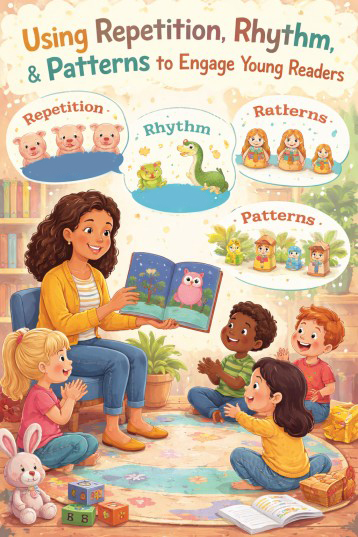
Repetition, rhythm, and patterns are powerful tools in children’s storytelling because they match how young minds naturally learn. Children understand and remember stories better when they hear familiar words, phrases, or structures repeated throughout the book.
Repetition is not just about saying the same thing again—it creates comfort, builds anticipation, and encourages participation.
-
Repetition helps children predict what happens next.
When a phrase or action repeats, children begin to expect it. For example, if a character says the same line on every page, children often start saying it aloud before it appears. This makes reading interactive and enjoyable.
-
Repetition improves memory and understanding.
Hearing the same words or patterns multiple times helps children remember vocabulary, sentence structure, and story flow. This is especially important for early readers who are still developing language skills.
-
Repetition increases engagement and confidence.
When children recognize patterns, they feel more confident because they understand what’s happening. This keeps them interested and encourages them to stay involved in the story.
-
Rhythm makes the story more musical and enjoyable.
Using a natural flow of words, similar to a rhyme or beat, makes the story pleasant to read aloud. Rhythm helps maintain attention and makes the story feel smooth and lively.
-
Patterns create structure and familiarity.
Stories that follow a repeating pattern—such as a character meeting different people in the same way—are easier for children to follow. This structure helps them focus on the meaning rather than trying to understand what comes next.
These techniques become even more effective when combined with illustrations. Repeated visual elements—like the same character pose, object, or scene layout—reinforce the text and help children connect words with images more easily.
Well-used repetition and rhythm do more than make a story fun—they turn reading into an active experience, helping children learn, remember, and participate at the same time.
How Visual Storytelling Enhances Written Narratives in Children’s Books
In children’s books, illustrations are not separate from the story—they are part of the storytelling itself. Young readers do not process text and images independently. Instead, they combine both to understand meaning, emotion, and sequence.
This means a well-illustrated book does not simply show what is written. It expands the story, controls attention, and helps the reader interpret what matters on each page.
-
Guiding attention to what is important.
Illustrations direct the child’s focus. Size, color, and placement of elements tell the reader where to look first, what to notice next, and what is most important in the scene. This is especially useful when the text is minimal.
-
Reducing the need for explanation in text.
Instead of describing actions or emotions in detail, visuals can communicate them instantly. For example, fear can be shown through posture and environment, removing the need for long sentences and keeping the story simple.
-
Creating emotional continuity across pages.
Consistent visual cues—such as color tones, character expressions, or repeated elements—help carry emotions from one page to the next. This makes the story feel connected rather than fragmented.
-
Adding parallel storytelling layers.
Illustrations can show actions or details that are not mentioned in the text. Background elements, secondary characters, or visual humor create an additional layer of storytelling that rewards careful observation.
-
Supporting early readers in decoding the story.
Children who are still learning to read use images to confirm what they think the text is saying. This builds confidence and helps them follow the narrative independently.
Strong visual storytelling does not repeat the text—it works alongside it. When done well, it reduces cognitive effort, increases engagement, and allows children to experience the story more naturally.
Writing Natural and Engaging Dialogue for Children’s Characters
- Use short and clear sentences that match how children naturally speak
- Keep the language simple so it is easy for young readers to understand instantly
- Make dialogue playful by adding fun words, sounds, or expressions
- Write lines that sound good when read aloud by parents or teachers
- Give each character a slightly different way of speaking to show personality
- Avoid long explanations and let dialogue stay direct and focused
- Use repetition in dialogue to make it more memorable and engaging
- Include emotional words that clearly show how the character feels
- Keep conversations active so something is always happening or moving forward
- Limit the number of words in each line to maintain attention
- Use familiar everyday words instead of complex vocabulary
- Add small reactions like “wow”, “oh no”, or “yay” to make dialogue lively
- Ensure dialogue matches the age and understanding level of the reader
- Break dialogue into small parts so it is visually easy to follow on the page
- Let dialogue support the story instead of repeating what is already shown
Balancing Imagination with Real Emotions in Children’s Stories
Strong children’s stories combine imaginative elements with real emotions, allowing young readers to enjoy creativity while still feeling deeply connected to the characters and their experiences.
Using Imagination to Capture Attention
Imagination helps draw children into the story and keeps them curious about what will happen next.
- Introduce creative elements like flying animals, magical lands, or talking objects
- Use fantasy to make the story exciting and visually engaging
- Create unique worlds that spark curiosity and wonder
- Keep imaginative ideas simple so children can easily follow them
- Use repetition in magical elements to build familiarity and interest
- Ensure fantasy supports the story instead of distracting from it
Grounding the Story in Real Emotions
Emotional connection is what makes the story meaningful and memorable for young readers.
- Focus on emotions like friendship, fear, happiness, and belonging
- Make characters react in ways children can relate to
- Show emotions through actions and expressions rather than long explanations
- Connect every major event to how the character feels
- Use emotional challenges to give meaning to the story
- End with a clear emotional resolution that feels satisfying
Showing Character Growth Without Making the Story Feel Like a Lesson
A strong children’s story teaches something meaningful, but it should feel natural and not forced or overly instructional.
Instead of directly stating the lesson, focus on how the character experiences challenges and gradually changes over time.
- Show character growth through clear actions rather than explaining the lesson in words
- Allow the character to make mistakes so children can see a realistic learning process
- Use consequences in the story to demonstrate what happens after each choice
- Let the character struggle with the problem before finding a solution
- Show gradual improvement instead of a sudden or unrealistic transformation
- Repeat similar situations to highlight how the character responds differently over time
- Use dialogue to reflect how the character’s thinking or attitude has changed
- Include reactions from other characters to show the impact of the main character’s growth
- Avoid clearly stating the moral, and let the message come through naturally
- Trust young readers to understand the lesson by observing what happens in the story
- Show emotional development, such as increased confidence, kindness, or courage
- Keep the lesson closely connected to the main conflict of the story
- End the story with a resolution that clearly reflects the character’s growth
- Use scenes and visuals to reinforce the change instead of explaining it directly
- Maintain a balance between storytelling and meaning so the story remains enjoyable
Crafting a Satisfying Ending That Children Understand and Remember
A strong ending in a children’s book is not just about finishing the story—it is about giving clarity, emotional closure, and a sense of completion that young readers can easily understand.
Children need endings that feel clear and earned, where they can see how and why things changed.
- Resolve the main problem in a clear and direct way so children are not left confused
- Ensure the solution connects logically to the actions taken earlier in the story
- Show how the character has changed by comparing their behavior to the beginning
- Reflect the emotional journey by showing how the character feels at the end
- Avoid introducing new problems at the end, as this can break the sense of closure
- Keep the ending simple so it is easy for children to process and remember
- Use familiar elements from earlier in the story to create a sense of completion
- Reinforce the central idea through actions instead of directly stating a lesson
- Create a positive or comforting final emotion, even if the story had challenges
- Use repetition or a callback line to make the ending more memorable
- Ensure the final scene visually and emotionally matches the tone of the story
- Avoid overly long endings, and conclude soon after the problem is resolved
- Let the reader feel that the journey is complete rather than abruptly stopped
- Make the ending satisfying enough that children want to revisit the story again
Common Mistakes to Avoid When Writing Children’s Stories
Many authors focus heavily on publishing, formatting, or illustration, but the core strength of a children’s book always comes from clear and effective storytelling.
Understanding common mistakes helps you avoid weak structure, confusion, and loss of reader interest.
- Avoid overcomplicated plots that are difficult for children to follow or remember
- Keep the story focused on one main idea instead of multiple disconnected events
- Ensure the main character has a clear goal or problem from the beginning
- Avoid weak character motivation, as children need to understand why actions are happening
- Limit the number of characters so the reader can easily recognize and remember them
- Give each character a clear role instead of introducing unnecessary additions
- Avoid long descriptions that slow down the pace of the story
- Do not rely only on narration when actions and visuals can explain better
- Avoid preachy or direct moral lessons that feel forced or unnatural
- Let the message come through the story instead of explaining it at the end
- Maintain consistency in character behavior and story logic
- Avoid sudden or unexplained changes in the storyline
- Ensure the conflict is introduced early and developed clearly
- Do not rush the ending, and allow proper resolution of the main problem
- Keep language appropriate for the target age group to maintain readability
How to Test Your Children’s Story Before Publishing
You don’t need expert tools or a formal process to test your story. A few simple checks can quickly show whether your story is clear, engaging, and easy for a child to understand.
The goal is not perfection—it is to see how a real child responds to your story.
- Read the story aloud to check if the sentences flow naturally and sound engaging
- Notice if any lines feel too long, confusing, or difficult to say
- Share the story with one child and observe their attention from beginning to end
- Watch if they stay focused or start losing interest at certain points
- Ask simple questions like “What happened in the story?” to check clarity
- See if they understand the main idea without needing explanation
- Observe their reactions to emotional moments like fun, fear, or excitement
- Notice if they laugh, smile, or show curiosity during key scenes
- Pay attention to parts where they seem confused or ask questions
- Check if they remember the main character after hearing the story
- Ask what they liked most to identify your strongest moments
- Look for sections that feel slow and may need to be shorter
- Make small changes based on what you observe instead of rewriting everything
- Test again after changes to see if the story feels smoother and clearer
This step helps improve clarity and engagement before you invest in book editing services or publishing.
How Professional Story Development Enhances Children’s Book Success
Before thinking about publishing, the most important step is making sure your story is clear, engaging, and well-structured.
Many first-time authors have a great idea, but struggle to turn it into a clear and engaging story. This is where story development plays a key role.
Story development is the process of refining your idea so it works effectively for young readers.
- It helps structure your story with a clear beginning, middle, and ending
- It ensures the main character has a strong and relatable goal or problem
- It improves pacing so the story moves smoothly without losing attention
- It removes confusion by simplifying ideas and focusing on what matters
- It strengthens emotional connection so children can relate to the story
- It ensures the message comes through naturally without feeling forced
- It aligns text and visuals so both work together effectively
- It identifies weak sections and improves them before illustration or publishing
- It creates a more engaging and memorable reading experience
- It increases the chances of children wanting to read the book again
A well-developed story becomes the foundation for everything that follows. Illustrations, design, and publishing can enhance a book—but they cannot fix a weak story.
Final Thoughts
Publishing options like self publishing companies amazon, amazon publishing, and various book publishing services are more accessible than ever. But access to tools does not guarantee a meaningful book—strong storytelling does.
A successful children’s book is built on simple but powerful foundations: real emotions that children can relate to, a clear structure that is easy to follow, and characters that feel genuine and memorable.
In children’s literature, the goal is not just to complete a book, but to create an experience that a child understands, enjoys, and remembers over time.
To explore more self publishing tips and resources that can guide you in writing, designing, and publishing your book, click on this link.
Click here to visit our Home Page.
Click here to view the portfolio of children’s book illustrations by Blueberry Illustrations:
https://blueberryillustrations.com/childrens-book-illustrationsClick here to explore affordable publishing packages offered by Blueberry Illustrations:
https://blueberryillustrations.com/affordable-publishing-packagesClick here to read author testimonials and reviews of Blueberry Illustrations:
https://blueberryillustrations.com/book-reviewClick here to view the Amazon book store featuring books published by Blueberry Illustrations:
https://blueberryillustrations.com/book-storeClick here to watch videos showcasing Blueberry Illustrations’ publishing and illustration work:
https://blueberryillustrations.com/videos