Our Happy
Authors


Featuring Your Child, Family, Pets and Familiar Places—with a Written Story, Short Captions, or Pictures Alone
Personalized illustrated books turn your child, family members, pets, and familiar places into characters and settings within a book. Using your photographs as references, an illustrator creates new artwork that follows their recognizable features. The book can recreate real memories or introduce an imaginary adventure, with a written story, short captions, or pictures alone.
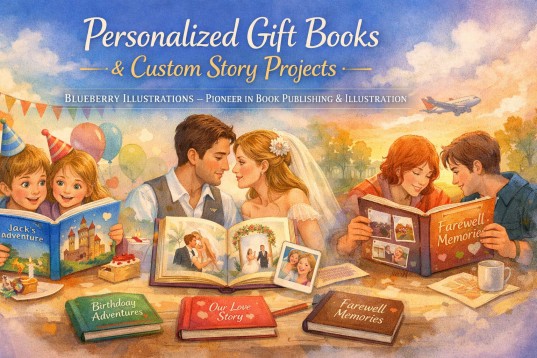
The illustrations can recreate real experiences or take familiar characters on imaginary adventures. A child and their dog might search for treasure in their own backyard or explore a make-believe world together. You do not need photographs of every activity: separate references can guide new scenes, poses, and expressions.
Your book can include a written story, short captions, or pictures alone. In a wordless book, the actions and expressions carry the story from page to page. This guide explains what you can personalize, which photographs to provide, and how to plan a book that keeps your characters and places consistent throughout.
When planning a personalized illustrated book, decide how much of its visual world should be based on real life. You might include one recognizable main character in an imaginary setting, or bring together family members, pets, familiar surroundings, and favorite belongings.
Photographs can guide each character’s facial features, hairstyle, skin tone, glasses, and body proportions. You can also specify their clothing and the age they should appear. If siblings appear together, their relative heights should remain consistent as they move through different scenes.
A pet can be the main character or a companion. Its appearance can reflect distinctive coat markings, ear shape, muzzle, tail, and familiar accessories. For example, a dog with one folded ear and a white chest patch should retain those features whether it is running, sleeping, or looking back at the reader.
Illustrations can include a particular house, bedroom, garden, playground, or another location you choose. Identify the features that make the place familiar, such as a front porch, a curved garden path, or a window seat. Less important details can be simplified so the setting supports the action without overwhelming it.
A much-loved teddy bear, patterned blanket, bicycle, or pet’s bed can appear in the scenes. These objects can also connect events across the book: a child might leave home with their favorite toy, carry it through an adventure, and return with it on the final page.
Make a short list of details that must match your references and those the illustrator can invent. This helps preserve the features that matter to you while allowing new poses, expressions, and activities. You can explore different visual approaches in our children’s book illustration portfolio.
🎂 Birthday Storybooks
💍 Wedding & Anniversary Books
👋 Farewell & Memory Books
👨👩👧 Family & Legacy Books
💕 Relationship & Friendship Books
👶 Baby & Newborn Storybooks
🎓 Graduation & Achievement Books
In the end, no matter the occasion, these books serve one purpose—to capture relationships, emotions, and memories in a way that can be revisited over time. A well-made personalized book becomes something people hold onto, not just as a gift, but as a reminder of moments and connections that matter.
Most gifts are appreciated in the moment, but their impact often fades with time. A personalized book works differently because it represents a story rather than a single object. It can be read again, shared with others, and kept as a long-term memory.
What makes these books stand out is the depth they offer. Instead of a single message or image, they combine multiple moments into a continuous narrative. The addition of illustrations further strengthens the connection by making the story more engaging and easier to visualize.
This is why more people are now choosing to create a picture book when looking for something meaningful. It allows them to present memories in a way that feels complete, personal, and emotionally rich, making the gift more memorable than traditional options.
Choose photographs that clearly show the features your illustrator needs to reproduce. A small, organized selection with clear instructions is more useful than a large collection showing different ages, hairstyles, or appearances without explanation.
Include a front-facing photograph, a three-quarter view, and a full-body picture where possible. These help establish facial features, hair shape, and body proportions. Naturally lit photographs without filters are useful for judging skin, hair, and eye colors.
If the photographs show different appearances, identify which one to follow. For example: “Use her face and glasses from the current photograph, but the shoulder-length hairstyle from the summer picture.” For several family members, note their relative heights if they are not photographed together.
Provide a clear face photograph and views of both sides of the body, including the paws and tail. This is particularly helpful when markings are uneven. A photograph of the pet standing naturally also shows proportions that may be difficult to judge from a close-up portrait.
Point out details that could be missed, such as a white paw, a patch beneath the chin, or an ear that folds differently. Mention if a reference photograph has been mirrored so markings are placed on the correct side.
Start with a wide view showing the overall arrangement, then add closer photographs of important features. For a bedroom, this might mean one image showing the bed, window, and doorway, followed by a closer view of a particular headboard or wallpaper pattern.
If the location appears repeatedly, photographs from more than one direction help the illustrator understand how its features connect. Explain which furnishings or background objects should be included and which can be left out.
Use descriptive filenames such as “Ella-current-hairstyle.jpg,” “Milo-right-side-markings.jpg,” and “Grandmas-house-front.jpg.” Add a short note identifying the main reference for each character or place and any details to take from other photographs.
You do not need a photograph of every planned action. The references establish appearance; the illustrator uses them to create the new poses and scenes required by your book.
A personalized illustrated book can recreate something that happened, invent an adventure around familiar characters, or combine both approaches. Your photos help establish who and what appears in the illustrations; the story determines what those characters experience.
A first visit to the seaside, an afternoon with grandparents, or the arrival of a family pet can become the starting point. Choose a few connected moments rather than trying to include every detail. For example, a seaside book might follow a child packing a favorite bucket, building a sandcastle, and bringing a shell home.
For this approach, identify which details should remain accurate: who was there, what they wore, where the event happened, and any objects that mattered. Also note anything you are comfortable simplifying or leaving out.
The characters can resemble your child and pet while taking part in an entirely imagined story. A dog might become a garden detective, or a child might discover that a familiar bedroom window opens onto a moonlit forest.
Recognizable details help connect the fantasy to the reader. A pet's distinctive markings, a child's favorite jacket, or the shape of the family home can remain familiar even when the events are invented.
A real setting can provide the beginning and ending of an imaginary journey. For instance, a child and grandparent could plant seeds in their own garden, imagine exploring a giant vegetable jungle, and return to water the seedlings together.
Before the illustrations begin, separate the details that must match your references from those the illustrator can invent. This gives the book a clear creative direction while preserving the personal connections that matter to you.
Photo references often contain more information than the finished illustrations need. Decide which details will help the reader recognize their world and which should be simplified, changed, or left out.
You can use first names, family nicknames, or fictional names. A child might recognize “Nana” more readily than a grandparent’s full name. Provide the exact spelling and preferred form of each name before captions, dialogue, or cover wording are prepared.
A front door, garden swing, or favorite reading corner may be enough to suggest a familiar place. House numbers, street signs, school names, and vehicle registration plates can be omitted unless they serve a specific purpose in the book.
Tell the illustrator about anything that should not appear in the artwork. This could include unrelated people in the background, visible documents, logos on clothing, or temporary clutter. Explain whether these elements should be removed or replaced with something simpler.
Discuss how your reference photos and finished illustrations may be used. Having artwork created for your book and allowing it to appear in a public portfolio or social media post are separate decisions. State your preferences clearly, particularly when the references show children or private family spaces.
A short “include, simplify, leave out” note alongside your photos gives the illustrator useful direction without requiring every visible detail to appear on the page.
Your favorite photographs may come from different years. Before they become illustration references, choose the age and appearance each character should have in the book. This helps avoid accidentally combining a toddler’s face, an older child’s height, and a hairstyle from another stage.
Identify the photograph that best represents how the person or pet should look. Use additional photos to clarify details such as hair, markings, or facial features. Label these supporting images so the illustrator knows which details to follow.
For a story set during one adventure, the characters will usually keep the same age throughout. A book following several years of family memories may show them growing older. If appearances change, identify where those changes happen in the story.
Mention details that photographs alone might leave unclear. For example: “Use her current short haircut, but keep the glasses shown in the school photo,” or “Show our dog as a puppy, before his muzzle turned grey.”
Separate photographs do not always show how tall people are compared with one another. A group photo or a simple note can clarify that one sibling is taller, a toddler reaches a parent’s waist, or a dog is small enough to sit comfortably on the child’s lap.
These choices establish a clear version of each character for the illustrator to follow across the book.
A photograph captures one moment, but an illustrated book may show the same person or pet running, resting, laughing, or looking surprised. Decide which features should remain recognizable and which details can change as the story unfolds.
A child’s hair texture, a parent’s glasses, or a pet’s distinctive markings can help readers recognize the character in different poses. Point out features that matter to you, including details that may be difficult to see in some of your reference photos.
A smiling reference photo does not mean the character must smile on every page. Their expression and posture should suit the moment: concentrating while building something, looking puzzled by a discovery, or relaxing beside a familiar pet.
Characters might wear the same outfit throughout a single afternoon, then change into pajamas at bedtime. If a particular outfit matters, identify where it should appear. Otherwise, agree on suitable clothing rather than asking the illustrator to copy a different outfit from every photograph.
A pet can behave as it does in everyday life or become a story character that talks, dresses up, and joins imaginary adventures. Choose the approach before the scenes are drawn. Even in a fantasy story, familiar markings, ear shapes, and body proportions can help the pet remain recognizable.
Review the initial character sketches before they appear throughout the book. This is the stage to confirm whether the illustrated version captures the person or pet you intended, and to resolve details that could otherwise carry into every scene.
An illustrated character may simplify facial features, but the combination should still feel recognizable. Look at the face shape, hairstyle, glasses, and proportions together. For pets, check the silhouette, muzzle, ears, and markings rather than judging resemblance by coat color alone.
Give specific feedback. “Make his hair shorter above the ears” or “Keep the white patch on her left front paw” gives clearer direction than “It does not look right.” Identify the reference photograph that best shows the correction.
A character should remain recognizable while smiling, looking surprised, turning sideways, or moving through a scene. Compare features that should stay consistent, such as hair length, eye color, and pet markings. Expressions and the visible shape of the face will naturally change with the pose and viewing angle.
If a room or garden appears more than once, check the arrangement of its main features. A doorway should connect to the same part of the room, and a garden gate should remain in a sensible position relative to the path. Different viewpoints can reveal different details without changing the underlying setting.
First check the identifying details, then look at what is happening in the picture. Can you recognize the characters? Is the intended action clear? This helps distinguish a likeness correction from a request to change the scene’s composition.
Send corrections as one numbered list with page references. After revisions, compare the updated sketches with your notes and confirm which version should guide the remaining illustrations.
A personalized book can tell its story through narration, short captions, or illustrations alone. Choose the approach before planning the individual scenes, because it affects what each picture needs to communicate and how much space should remain for text.
Narration and dialogue can explain what the characters think, say, or remember. This approach is useful when personal details cannot be shown clearly in a picture, such as a family saying, a pet’s nickname, or the reason a particular place matters.
For example, a picture might show a child and their dog beside a garden gate. The accompanying words could explain: “Every afternoon, Maya and Buddy checked whether Grandpa’s strawberries were ready.” The illustration establishes the familiar characters and setting, while the text adds context.
Captions provide a few words of direction while leaving most of the action to the illustrations. The same garden scene might simply read, “Time to check the strawberries!” This format can suit a sequence of familiar activities where long explanations are unnecessary.
Keep captions focused on what matters in that moment. Names, brief dialogue, and repeated phrases can connect the scenes without describing every visible detail.
A wordless book needs a clear sequence of actions that readers can follow visually. Expressions, gestures, and changes between pictures must communicate information that narration would otherwise provide.
For the strawberry example, one picture could show Maya noticing a ripe berry, the next could show Buddy sniffing it, and a final picture could show them carrying a small basket to Grandpa. The familiar people, pet, and garden remain personalized, while the pictures carry the story.
Review a rough sequence of the pages before detailed artwork begins. For a wordless book, look through it without explaining the action to someone else and ask what they think happened. For a book with text, check that the words add useful meaning and that space has been reserved for them.
You can also combine approaches—for example, mostly wordless scenes with an occasional spoken phrase. The amount of text should follow how you want the story to be experienced.
Before choosing how your book will be created, check what “personalized” includes. Changing a name in an existing story is a different service from developing illustrations around your photographs, characters, and chosen settings.
Some books use an existing story and artwork, with options to change the main character’s name or add a dedication. This can suit someone who likes the original book and wants a personal message, but it does not necessarily include a character who resembles the reader.
Other books let you choose from available hairstyles, skin tones, clothing, or accessories. Ask whether these are preset combinations or whether an illustrator can adjust specific features from photographs. A selection of options may not capture details such as a particular face shape or a pet’s uneven markings.
A fully custom illustrated project can use your photographs to establish character appearance and familiar locations, then depict them in new scenes. Confirm whether the proposed scope includes original scene compositions, additional family members, pets, and any real places you want shown.
For example, a book featuring a child and their dog might require more than changing names: the child’s glasses, the dog’s markings, and the layout of their garden may all need to appear consistently throughout the artwork.
Choose the level of personalization that matches your expectations. Clear answers at the beginning help you understand what the finished book will include and compare proposals on the same basis.
Blueberry Illustrations creates custom book illustrations using your photographs as references for children, family members, pets, and familiar places. Your book can follow real experiences or take recognizable characters into an imaginary adventure, with a written story, short captions, or pictures alone.
To discuss your project, share a brief outline covering:
You can begin with an idea even if these details are not finalized. Browse our children’s book illustration portfolio to identify artwork you like, then send your project outline so we can discuss the scope and provide a quote.
Personalized books go beyond being simple gifts—they transform real experiences into stories that can be revisited and remembered for years. By combining personal moments with thoughtful storytelling and visuals, they create something far more meaningful than standard, off-the-shelf options.
However, the impact of a custom book depends largely on how well it is planned and executed. A clear storyline, well-crafted illustrations, and a professionally designed layout all contribute to making the book feel complete and engaging. Without this balance, even strong ideas can fall short in presentation.
This is where the role of experienced publishing teams becomes important. When writing, illustration, and design are handled together with a structured approach, the result is more consistent, visually appealing, and emotionally effective.
In the end, a well-created personalized book is not just a one-time gift—it becomes a lasting keepsake that holds both creative and emotional value, making the effort and attention to detail truly worthwhile.
To explore more self publishing tips and resources that can guide you in writing, designing, and publishing your book, click on this link.
Click here to visit our Home Page.
Click here to view the portfolio of children’s book illustrations by Blueberry Illustrations: https://blueberryillustrations.com/childrens-book-illustrationsClick here to explore affordable publishing packages offered by Blueberry Illustrations: https://blueberryillustrations.com/affordable-publishing-packagesClick here to read author testimonials and reviews of Blueberry Illustrations: https://blueberryillustrations.com/book-reviewClick here to view the Amazon book store featuring books published by Blueberry Illustrations: https://blueberryillustrations.com/book-storeClick here to watch videos showcasing Blueberry Illustrations’ publishing and illustration work: https://blueberryillustrations.com/videos