Our Happy
Authors


A Complete Guide to Creative Collaboration and Book Illustration Workflow
Creating an illustrated book is a collaborative process in which words and images must work together. The author develops the story, characters, voice, and narrative direction, while the illustrator interprets those ideas visually through character design, expressions, settings, composition, and visual storytelling. Although their responsibilities are different, the strongest illustrated books are often created when both roles contribute to a shared creative vision.
Effective author–illustrator collaboration involves much more than sending a manuscript to an artist and waiting for finished pictures. Decisions must be made about characters, important story details, scene interpretation, visual continuity, sketches, revisions, and how the illustrations interact with the text. Authors need to communicate essential requirements clearly, while illustrators need enough creative freedom to use their visual expertise.
This guide explains how authors and illustrators work together throughout the illustration process—from preparing the manuscript and establishing the visual direction to developing characters, reviewing sketches, exchanging feedback, resolving creative differences, and approving the final artwork. It also explains where the responsibilities of the author and illustrator differ, where they overlap, and how a well-managed collaboration can turn a written manuscript into a cohesive illustrated book.
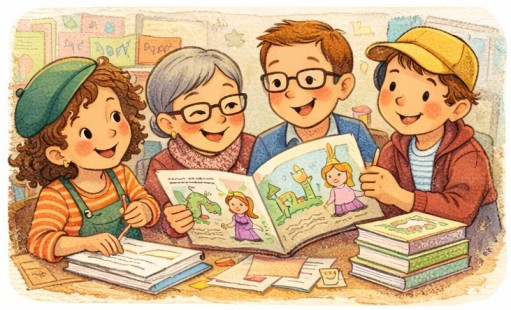
Authors and illustrators approach a book from two different creative perspectives. The author knows the story from the inside—its characters, events, emotions, themes, and important details. The illustrator approaches the same manuscript visually, deciding how those ideas can be communicated through character appearance, expressions, body language, settings, composition, perspective, and other visual elements.
The collaboration works best when both sides understand what information needs to be communicated and which decisions belong primarily to each role. An author may know that a character must appear nervous when entering a new school, for example, but the illustrator may determine how that nervousness is shown through posture, facial expression, positioning, and interaction with the surrounding scene.
This means the illustrator is not simply reproducing the author's words as pictures. Illustration adds a second layer of storytelling. An image can reveal a character's reaction, establish the atmosphere of a location, introduce visual humor, show relationships between characters, or provide details that would be unnecessary to explain in the written text.
At the same time, creative freedom does not mean ignoring the manuscript. Certain details may be essential to the story and must be communicated clearly by the author. A character's age, an important object, a particular action, a historical setting, or a detail that becomes significant later in the story may need to appear accurately in the artwork.
A productive author–illustrator relationship therefore depends on a balance between clear story requirements and professional visual interpretation. The author communicates what the story requires, while the illustrator contributes expertise in deciding how those requirements can work visually.
An author and an illustrator contribute different forms of storytelling to an illustrated book. The author is responsible for the written narrative, while the illustrator develops the visual narrative that accompanies, expands, and sometimes communicates information beyond the words. Their roles are distinct, but the finished book depends on the two working together.
The author's responsibility begins with the manuscript. The author establishes the characters, events, dialogue, themes, and information that the story must communicate. When illustration begins, the author also needs to identify details that are essential to the story so that they are represented accurately in the artwork.
The illustrator translates the manuscript into a visual world. This involves interpreting characters and settings, deciding how scenes should be composed, showing emotion through expressions and body language, establishing perspective and visual emphasis, and maintaining consistency as characters and locations appear throughout the book.
| Author | Illustrator |
|---|---|
| Creates the written story and narrative structure | Creates the visual interpretation of the story |
| Defines essential characters, events, and story facts | Develops how characters, events, and settings appear visually |
| Communicates details that must remain accurate | Makes visual decisions about composition, perspective, expressions, and atmosphere |
| Reviews whether artwork remains faithful to important story requirements | Maintains visual consistency and develops the visual storytelling across the book |
There is also an important area of overlap. Character interpretation, mood, visual pacing, and the treatment of important scenes may require input from both sides. The author contributes knowledge of the story and its intentions, while the illustrator contributes knowledge of visual communication. Collaboration allows those two perspectives to meet without requiring either person to perform the other's role.
Author–illustrator collaboration should usually begin when the manuscript is sufficiently developed for the illustrator to understand the complete story. The text does not necessarily need to be typeset or designed at this stage, but the storyline, characters, sequence of events, and major scenes should be stable before detailed illustration work begins.
This is important because illustrations are often connected to specific actions, page turns, character details, and moments in the manuscript. If major sections of the story change after character designs or scene sketches have been approved, previously completed artwork may no longer fit the narrative.
Before illustration begins, the author should therefore identify any unresolved elements that could affect the artwork. These may include:
Early collaboration does not mean that every visual decision must be settled before the illustrator starts. In fact, some ideas become clearer only after character concepts and preliminary sketches are created. The objective is to establish the essential story requirements first while leaving room for the illustrator to explore how those requirements can be communicated visually.
It is also useful to distinguish between changes to the story and changes to its visual interpretation. Story changes are primarily the author's responsibility and are best resolved before illustration progresses too far. Visual questions—such as composition, expressions, perspective, and how a particular moment should be staged—can then be explored collaboratively during character development and sketching.
Starting with a stable manuscript and clearly identified story requirements gives both author and illustrator a reliable foundation. It reduces unnecessary reworking while still allowing the visual side of the book to develop creatively as the collaboration progresses.
Before individual scenes are developed, the author and illustrator should establish a shared understanding of what the book should feel like visually. This does not mean deciding every artistic detail in advance. It means agreeing on the fundamental direction so that later creative decisions are made within the same visual world.
The manuscript provides the starting point, but two people can read the same story and imagine it very differently. An author may picture a scene as gentle and humorous, while an illustrator may initially interpret it as energetic and exaggerated. Neither interpretation is necessarily wrong, but identifying these differences early prevents an entire set of illustrations from developing in an unintended direction.
Useful points to discuss at this stage include:
References can help communicate ideas that are difficult to describe in words. An author might provide photographs of a particular location, clothing, hairstyle, historical object, animal, or other detail that needs to be represented accurately. References can also help communicate a general mood or atmosphere.
However, references should usually communicate information and direction rather than prescribe an exact finished illustration. If every pose, expression, object, angle, and placement is predetermined, the illustrator has little opportunity to solve the scene visually or contribute ideas that could strengthen the storytelling.
A useful distinction is between fixed requirements and creative possibilities. If a character must wear a red backpack because it becomes important later in the story, that is a fixed requirement. Whether the character carries it over one shoulder, places it beside a chair, or holds it while speaking may be a visual decision that can be explored during sketching.
A successful collaboration depends on the illustrator receiving enough information to understand the story without being overwhelmed by unnecessary instructions. The manuscript should remain the primary source of information, but some visual details may not be obvious from the text and should be communicated separately.
Before illustration begins, authors should identify which details are essential to the story and which are simply personal preferences. Essential information should be communicated clearly because the illustrator may otherwise make a perfectly reasonable visual interpretation that differs from what the author had imagined.
Useful information to provide may include:
Authors should also explain the reason behind an important requirement whenever that reason is not obvious. For example, telling an illustrator that a necklace must appear in every scene is useful, but explaining that the necklace becomes important near the end of the story helps the illustrator understand why its visibility and consistency matter.
At the same time, authors do not need to describe everything that can reasonably be interpreted from the manuscript. Instructions about every facial expression, hand position, background object, viewing angle, or character placement can make the brief unnecessarily restrictive and may prevent the illustrator from finding a stronger visual solution.
A useful illustration brief therefore separates information into three categories: what must be shown, what would be preferred, and what the illustrator is free to interpret. This distinction gives the illustrator clear boundaries while preserving enough creative freedom for visual storytelling.
One of the most important parts of author–illustrator collaboration is deciding where author direction ends and illustrator interpretation begins. The author understands the story, characters, and narrative requirements, but the illustrator brings expertise in visual storytelling. A productive collaboration gives both roles appropriate influence rather than allowing either side to control every decision.
Authors should generally be specific about details that affect the meaning or continuity of the story. If a character must have a particular appearance, an object becomes important later, or an action needs to be clearly understood by the reader, those requirements should be communicated. They are part of the narrative rather than simply artistic preferences.
Other decisions can often be left to the illustrator. These may include:
For example, an author may need a scene to show that a child feels excluded while other children play together. That emotional situation is important to the story. The author does not necessarily need to specify where every child stands, the direction each character faces, or the exact expression on every face. The illustrator can explore composition, distance, posture, and visual focus to communicate the feeling effectively.
Too little direction can create problems because the illustrator may unknowingly change an important story detail. Too much direction can create a different problem: the illustrator becomes responsible for executing a predetermined arrangement rather than solving the scene as a visual storyteller.
This distinction becomes particularly important when an author has a very specific picture in mind. An imagined scene may work perfectly in the author's head but become crowded, visually confusing, or difficult to read when translated onto a book page. An experienced illustrator may suggest a different composition that preserves the meaning of the scene while communicating it more clearly.
Creative freedom should therefore operate within agreed boundaries. The author protects the integrity of the story, while the illustrator has room to determine how that story is communicated visually. When those responsibilities are understood from the beginning, creative differences are easier to resolve because both sides can distinguish between a necessary story requirement and a subjective visual preference.
Once the manuscript and creative direction are established, collaboration moves through a series of approval stages. The purpose of this workflow is not simply to organize production. It allows important creative decisions to be tested and corrected while they are still relatively easy to change.
Although the exact process varies by project, an illustrated book commonly develops through the following stages:
The approval points within this workflow are particularly important. Character designs should ideally be resolved before the same character is developed across many scenes, and major compositional concerns should be addressed at the sketch stage rather than after finished artwork has been created.
A structured workflow therefore protects both sides of the collaboration. The author has opportunities to verify that the visual storytelling remains faithful to the manuscript, while the illustrator can develop the artwork progressively without repeatedly rebuilding decisions that were already approved.
This workflow describes the sequence of collaboration rather than how long each stage takes. The schedule can vary considerably according to the number of illustrations, complexity of the artwork, revision requirements, and project structure.
Character development is one of the areas where the author's knowledge of the story and the illustrator's visual expertise need to work particularly closely together. The author knows who the character is, while the illustrator must determine how that personality, age, role, and emotional character can be communicated visually.
The author should identify characteristics that are important to the narrative. These may include age, physical features, personality, clothing, relationships with other characters, or distinctive objects associated with the character. If a particular feature becomes important later in the story, the illustrator should know about it before the design is finalized.
The illustrator then interprets this information visually. Character development may involve decisions about proportions, facial features, hairstyle, clothing, posture, expressions, and other identifying characteristics. The objective is not only to create an appealing character, but also one who can communicate different emotions and actions consistently throughout the book.
Personality is particularly important. A shy child, an energetic child, and a mischievous child may require very different visual treatment even if the manuscript provides similar physical descriptions. Posture, expressions, gestures, clothing choices, and interaction with other characters can all help communicate personality without requiring additional explanation in the text.
During character review, authors should therefore look beyond whether a design matches the exact picture they originally imagined. More useful questions include:
When several characters appear together, their relationship also matters. Differences in height, age, posture, expression, clothing, and body language can help readers understand family relationships, friendships, authority, conflict, or affection before those relationships are fully explained in words.
At the same time, character development should remain collaborative rather than becoming a process of prescribing every visual detail. The author establishes who the character needs to be for the story, and the illustrator determines how that identity can be expressed effectively and consistently through artwork.
Once the characters and overall visual direction have been established, the author and illustrator begin making decisions about individual scenes. At this stage, the author's knowledge of what must happen in the story needs to be balanced with the illustrator's ability to determine how that moment can be communicated visually.
A useful scene description tells the illustrator what is important without attempting to design the entire composition. For example, an author may explain that a child has just discovered a lost puppy and should appear relieved and excited. Those details affect the meaning of the scene and are therefore useful direction.
The illustrator can then decide how to communicate that moment through character placement, expression, body language, perspective, environment, and visual emphasis. There may be several successful ways to illustrate exactly the same passage, and part of the illustrator's role is finding a visual solution that works effectively on the page.
Authors should be particularly clear about details that affect continuity or the meaning of the story, including:
Details that do not affect the narrative can often remain open to interpretation. The exact viewing angle, placement of secondary objects, background activity, gestures, and other compositional choices may be better determined during sketch development.
This distinction is especially useful when preparing illustration notes. A description such as “Emma finds the puppy underneath the old wooden bench and kneels beside him” communicates information the illustration needs to contain. Adding instructions for the exact position of every limb, object, tree, cloud, and background character may unnecessarily restrict the composition unless those details have narrative significance.
Illustrators may also identify opportunities that are not explicitly described in the manuscript. A background character might react humorously to the main action, a recurring object might appear quietly across several scenes, or the environment might reveal additional information about a character. These visual additions can enrich the book without requiring more written explanation.
There are situations in which detailed author direction is appropriate. A nonfiction or educational illustration may need factual precision. A story based on a real person or location may require specific visual references. Cultural, historical, religious, or technical details may also need careful direction to avoid inaccurate representation.
The goal is therefore not to give the illustrator as little direction as possible. It is to provide the right kind of direction: precise about elements that matter to the story and flexible about visual decisions that can benefit from the illustrator's expertise.
The sketch stage is one of the most important points in author–illustrator collaboration. A sketch allows the author to evaluate the visual interpretation of a scene before the illustrator invests time in finished artwork. This is the best stage for identifying problems with composition, character actions, expressions, important objects, and story accuracy.
Authors should review sketches primarily for whether the illustration communicates the intended story moment. A rough sketch may not contain finished facial details, colors, textures, lighting, or polished backgrounds, so judging it as though it were final artwork can lead to unnecessary changes.
When reviewing a sketch, it is useful to check:
Useful feedback should explain both what needs to change and, when relevant, why. For example, “Please make the grandfather look older” provides some direction, but “Please make the grandfather appear noticeably older because the story describes him as being in his seventies” gives the illustrator a clearer objective.
Authors should also distinguish between a correction and a preference. If the illustrator has drawn three children when the manuscript requires four, that is a correction. If the author simply prefers a character to stand on the opposite side of the scene, that may be a creative preference. Recognizing the difference can make discussions more productive.
Feedback is usually easier to implement when comments are specific and consolidated. Sending one complete review of a sketch allows the illustrator to consider how requested changes affect one another. A series of separate comments sent at different times can result in repeated adjustments or even contradictory instructions.
Vague feedback can be particularly difficult to interpret. Comments such as “I don't love it,” “make it more exciting,” or “something looks wrong” identify dissatisfaction but do not tell the illustrator what the author believes is missing. Describing the intended emotion, story issue, or visual concern gives the illustrator something concrete to solve.
Authors should also review carefully before giving approval. Approval normally indicates that the principal elements of the sketch—such as composition, character placement, actions, and important story details—are accepted. Discovering a major compositional change only after the illustration has been fully rendered can require considerably more reworking than making the same change during sketch development.
The purpose of feedback is not for the author to redesign the illustration personally. It is to communicate whether the artwork is serving the story and to identify specific issues that need attention. The illustrator can then determine the most effective visual way to address those concerns.
Creative differences are normal when two people are interpreting the same story. An author may have imagined a scene in a particular way for years, while the illustrator may see a different visual solution after considering composition, storytelling, and the way the scene needs to function on the page. The objective is not to eliminate these differences, but to determine which decisions are essential to the story and which allow room for interpretation.
When a disagreement occurs, the first question should be whether the issue affects the meaning or accuracy of the story. If an illustration contradicts the manuscript, changes an important character detail, omits a necessary object, or communicates the wrong event, the author's concern needs to be addressed.
If the disagreement concerns composition, perspective, pose, background treatment, or another artistic choice that does not alter the story, the illustrator should be able to explain the reasoning behind the visual decision. Sometimes an arrangement that differs from what the author originally imagined works better because it makes the action clearer, creates a stronger focal point, or communicates an emotion more effectively.
It can help to return to the original purpose of the scene rather than debating individual artistic choices. Instead of asking whether a character should stand on the left or right, for example, both sides can ask what the reader needs to notice first and which arrangement communicates that most clearly.
Some disagreements are also matters of personal taste rather than correctness. Recognizing this distinction is important. Collaboration becomes difficult when every difference from the author's original mental image is treated as an error, but it can be equally difficult when an illustrator dismisses legitimate story requirements as creative interference.
The strongest solution is usually the one that protects the author's narrative intention while allowing the illustrator to solve the visual problem professionally. A successful collaboration does not require both people to imagine every scene identically; it requires them to agree on what the illustration needs to communicate to the reader.
In an illustrated book, the text and artwork should not compete to tell exactly the same information. The author provides the written narrative, while the illustrator has an opportunity to expand that narrative visually. When both simply repeat one another, some of the storytelling potential of illustration is lost.
For example, if the text says that a child walks nervously into a classroom, the illustration does not necessarily need to reproduce every detail in the sentence literally. The artwork might show the child's hesitant posture, classmates turning to look, a tightly held backpack, or details in the environment that reinforce the feeling of entering an unfamiliar place.
Illustrations can contribute information that would otherwise make the manuscript unnecessarily descriptive. They can show:
This is particularly important in picture books, where readers receive the story from both words and images. An illustrator may be able to communicate information visually that the author can then avoid explaining in an additional sentence. Conversely, important information that cannot be understood reliably from the artwork may still need to remain in the text.
Authors should therefore consider what the reader already learns from the illustration before describing the same information in words. If the artwork clearly shows that a room is chaotic, for example, the text may not need to list every overturned toy, scattered book, and misplaced object. The words can move the story forward while the illustration supplies those visual details.
The illustrator must also consider the text when developing a scene. An illustration should support the narrative rather than introduce visual information that accidentally contradicts it. Details added creatively should remain compatible with the characters, setting, sequence of events, and overall logic of the story.
The relationship between text and illustration is also physical, not only narrative. When an illustration will share a page or spread with text, the composition should leave appropriate areas for typography rather than placing important faces, actions, or visual details where the words are likely to appear. Authors, illustrators, and book designers therefore need to consider text placement early enough for the artwork and typography to support rather than compete with each other.
The most effective author–illustrator collaboration therefore treats words and pictures as complementary parts of the same narrative. The author does not need to write everything that can be shown, and the illustrator does not need to draw only what has already been stated. Each medium can contribute something the other cannot, creating a richer story than either would provide alone.
When an author directly commissions illustrations for a self-published book, the author is the final authority over the creative direction and approval of the artwork, within the terms and scope agreed for the project. The illustrator contributes professional artistic expertise, but the illustrations are ultimately being created to serve the author's story and vision.
This means the author has the final say when deciding whether characters, scenes, emotions, settings, and important story details are represented appropriately. If an illustration contradicts the manuscript, changes an important event, misrepresents a character, or does not communicate the intended meaning of a scene, the author can request that it be corrected before approval.
Being the final authority does not mean that the author needs to personally design every aspect of an illustration. The illustrator brings expertise in composition, perspective, visual hierarchy, expressions, body language, use of space, color, and visual storytelling. Authors can benefit from allowing the illustrator to propose creative solutions rather than prescribing every artistic decision in advance.
For example, an author may decide that a particular scene must communicate loneliness and that the main character must be sitting apart from the other children. The illustrator may then determine the viewing angle, spacing between the characters, expressions, body language, background details, and composition that communicate that idea most effectively. The illustrator develops the visual solution, while the author reviews and ultimately approves whether it serves the story.
Some decisions naturally benefit from discussion between both sides. A character's personality originates in the author's story, but the illustrator may discover effective ways to express that personality through posture, clothing, gestures, expressions, or recurring visual details. The author can evaluate these ideas against the larger story while benefiting from the illustrator's visual perspective.
The situation can be different in traditional publishing. When a publishing house controls the production of the book, editors, art directors, designers, and publishers may participate in selecting the illustrator, directing the artwork, requesting changes, and approving illustrations. The author may therefore have less direct authority over the artwork than a self-publishing author who commissions an illustrator independently.
In a directly commissioned project, the most effective relationship is therefore one in which the author's final authority and the illustrator's professional expertise support rather than compete with each other. The author protects the story and makes the final approval decisions, while the illustrator contributes the visual knowledge needed to translate that story into effective artwork.
Authors do not always work directly with an individual illustrator. When illustrations are commissioned through an illustration company or studio, the creative relationship may also involve a project manager, art director, or another team member who coordinates communication between the author and illustrator.
The fundamental relationship remains the same: the author communicates the story requirements and reviews the developing artwork, while the illustrator interprets the manuscript visually. What changes is the way information, feedback, and approvals move through the project.
Depending on the company's working process, a project coordinator may help organize:
This additional layer of coordination should not remove the author's creative authority over a directly commissioned project. The author still reviews the artwork and makes the final approval decisions within the agreed scope. The purpose of project coordination is to help translate those decisions into a clear and organized production process.
Clear communication becomes especially important when feedback passes through another person. Comments should be recorded accurately and presented together so that the illustrator understands exactly what the author wants changed. Likewise, questions from the illustrator should reach the author when they involve story details that cannot reasonably be determined from the manuscript.
Some illustration companies may also assign different specialists to different parts of a project or provide additional art direction. In these situations, maintaining an established character design, visual direction, and approved references helps ensure that the book continues to feel visually consistent even when more than one professional contributes to its development.
Whether an author works directly with an individual illustrator or through a coordinated team, the principle remains the same: the illustrator needs clear access to the author's story requirements, the author needs meaningful opportunities to review the artwork, and approvals need to be communicated clearly before the project moves to the next stage.
Yes. Some books are created by an author-illustrator, meaning the same person writes the manuscript and creates the artwork. In that situation, the writing and visual storytelling are developed by one creator rather than through collaboration between two separate professionals.
This can give the creator a high level of control over the relationship between words and images. Because the same person understands both the written and visual intentions of the book, decisions about character appearance, scene composition, pacing, page turns, and visual details can be made without needing to communicate those ideas to another person.
However, combining both roles also means taking responsibility for two different creative disciplines. Writing a strong manuscript and creating effective sequential illustrations require different skills, and being confident in one area does not automatically mean the other will be equally strong.
An author-illustrator also needs to evaluate the book from both perspectives. Questions to consider include:
When the author and illustrator are different people, those two perspectives naturally challenge and refine one another. The author can identify whether the artwork remains faithful to the story, while the illustrator can introduce visual ideas the author may not have considered.
Neither approach is automatically better. An author-illustrator can create a highly unified book when both writing and illustration skills are strong, while a separate author and illustrator can benefit from the creative exchange between two specialists. The important factor is whether the words and images work together effectively in the finished book.
Many difficulties in an illustrated book project come from unclear expectations rather than from the quality of the writing or artwork. Recognizing common collaboration mistakes early can prevent unnecessary confusion and reworking.
Another mistake is assuming that successful collaboration means the author and illustrator must always have the same idea. Different interpretations are often useful. An illustrator may discover a stronger way to stage a scene, communicate an emotion, or use the page visually than the author originally imagined.
At the same time, creative interpretation should not override essential requirements of the manuscript. The author remains responsible for identifying what the story needs to communicate and, in a directly commissioned project, approving whether the artwork represents that vision appropriately.
The goal is therefore not to eliminate creative differences but to manage them constructively. When story requirements are clear, visual expertise is respected, and decisions are reviewed at the appropriate stages, authors and illustrators can concentrate on improving the book rather than repeatedly resolving preventable misunderstandings.
When an author directly commissions illustrations for a self-published book, the author retains final approval over the artwork within the agreed project scope. A skilled illustrator can offer recommendations, alternative visual solutions, and professional artistic judgment, but those contributions ultimately serve the author's story.
Authors and illustrators do not need to imagine every scene in exactly the same way. In fact, different perspectives can strengthen a book. What matters is that both understand what the story needs to communicate, discuss differences constructively, and work toward illustrations that complement the writing rather than simply repeat it.
When that balance is achieved, the relationship becomes more than a sequence of instructions and approvals. The author's narrative knowledge and the illustrator's visual storytelling skills combine to create a book in which the words and images feel like parts of the same story.
How do authors and illustrators work together?
Authors provide the manuscript, essential story information, character requirements, and creative direction, while illustrators interpret the story visually. Collaboration usually involves character development, scene planning, sketches, author feedback, revisions, and approval before the final artwork is completed.
What is the difference between an author and an illustrator?
An author creates the written story, including its characters, events, dialogue, and narrative direction. An illustrator creates the visual interpretation of that story through characters, settings, expressions, composition, and other visual elements. In an illustrated book, the two roles are different but work together to create the complete reading experience.
What should an author give an illustrator before starting a book?
The author should provide a stable manuscript along with essential information that may not be obvious from the text. This can include character details, important settings, recurring objects, factual or cultural requirements, story-critical actions, and useful visual references. Authors should distinguish between details that must be followed and areas where the illustrator can interpret the story creatively.
How much creative freedom should an illustrator have?
An illustrator should have enough creative freedom to make professional decisions about composition, perspective, expressions, body language, visual emphasis, and other aspects of visual storytelling. The author should clearly communicate elements that are essential to the story while allowing the illustrator to determine how many of those ideas can be represented most effectively.
Who has the final say, the author or the illustrator?
When a self-publishing author directly commissions an illustrator, the author normally has final approval over the artwork within the agreed project scope. The illustrator contributes professional artistic judgment and may recommend alternative visual solutions, but the finished illustrations ultimately need to represent the author's story and approved creative direction. In traditional publishing, the approval structure may also involve the publisher, editor, designer, or art director.
How should an author give feedback to an illustrator?
Feedback should be clear, specific, and preferably consolidated into one review at each stage. Authors should explain what needs to change and why when the reason is important to the story. Major concerns about characters, actions, composition, or missing story elements should ideally be identified while reviewing sketches rather than after the artwork has been finalized.
What happens if an author and illustrator disagree about an illustration?
The first step is to determine whether the disagreement concerns an essential story requirement or a visual preference. Story inaccuracies should be corrected, while artistic decisions such as composition or perspective may benefit from the illustrator's professional judgment. The best solution should preserve the author's narrative intention while allowing the illustrator to solve the scene effectively as visual storytelling.
Can an author also be the illustrator of a book?
Yes. A person who both writes and illustrates a book is commonly called an author-illustrator. This gives one creator control over both the written and visual storytelling, although writing and professional illustration require different creative skills.
Do illustrations need to show exactly what the text says?
No. Illustrations can complement the text rather than simply repeat it. They may communicate expressions, relationships, setting details, humor, secondary actions, atmosphere, and other information visually. When words and pictures contribute different but compatible information, they can create a richer reading experience.
A successful author–illustrator partnership begins with clear communication, a shared understanding of the story, and an illustration process that gives the author meaningful opportunities to review and approve the developing artwork.
At Blueberry Illustrations, we work with authors to develop their books through character design, scene planning, sketches, revisions, and final illustrations while keeping the author's story and creative vision at the center of the process.
Explore our children's book illustration services and portfolio to see different illustration styles and examples of our work.
If you are preparing to commission artwork, read our guide on how to hire a children's book illustrator for the practical steps involved in selecting and working with an illustrator.
Authors who want to understand how professional studios and illustration companies operate can also read our guide to illustration firms.
